
Written by: Segun Akomolafe
Most healthy adults basically need 3.7 litres (15.5 cups) of water a day for men, and about 2.7 litres (11.5 cups) for women, based on a National Academies of Sciences, Engineering and Medicine report. This figure actually includes water from food as well as drinks. It is not the same as gulping down large amounts of water from a bottle. Your actual number varies based on your size, activity level, and climate, but this range is a good baseline for just about anyone who’s trying to get a handle on their daily fluid needs.
Now, let’s take a look at how much water you should drink a day, why it fluctuates so much from one individual to another, and how you can determine your personal target rather than just making assumptions.

Daily Water Intake at a Glance
Before going deeper into the specifics, let’s take a look at what the research usually advises for the different demographics. It can be used as a guideline, but not as a set-in-stone rule.
Group | Recommended Total Water Intake |
|---|---|
Adult men (19 to 50 years) | About 3.7 L, roughly 15.5 cups a day |
Adult women (19 to 50 years) | About 2.7 L, roughly 11.5 cups a day |
Pregnant women | About 2.4 to 3.0 L, roughly 10 to 13 cups |
Breastfeeding women | About 2.8 to 3.8 L, roughly 12 to 13 cups |
Teens (14 to 18 years) | 2.4 to 3.3 L depending on sex and activity |
Adults 60 and older | Often 2.5 to 2.9 L, since intake tends to drop with age |
Why Your Body Needs This Much Water Every Day
Water is not just a drink you take between meals to be nice to your body. It accounts for about 60 percent of your total weight and is involved in virtually every process occurring inside your body at this moment—from delivering nutrients to your muscles, to cushioning your joints, to ensuring that your kidneys function properly. Skip too much of it and your body starts to take shortcuts and you’re going to feel that before you see it on a scale.
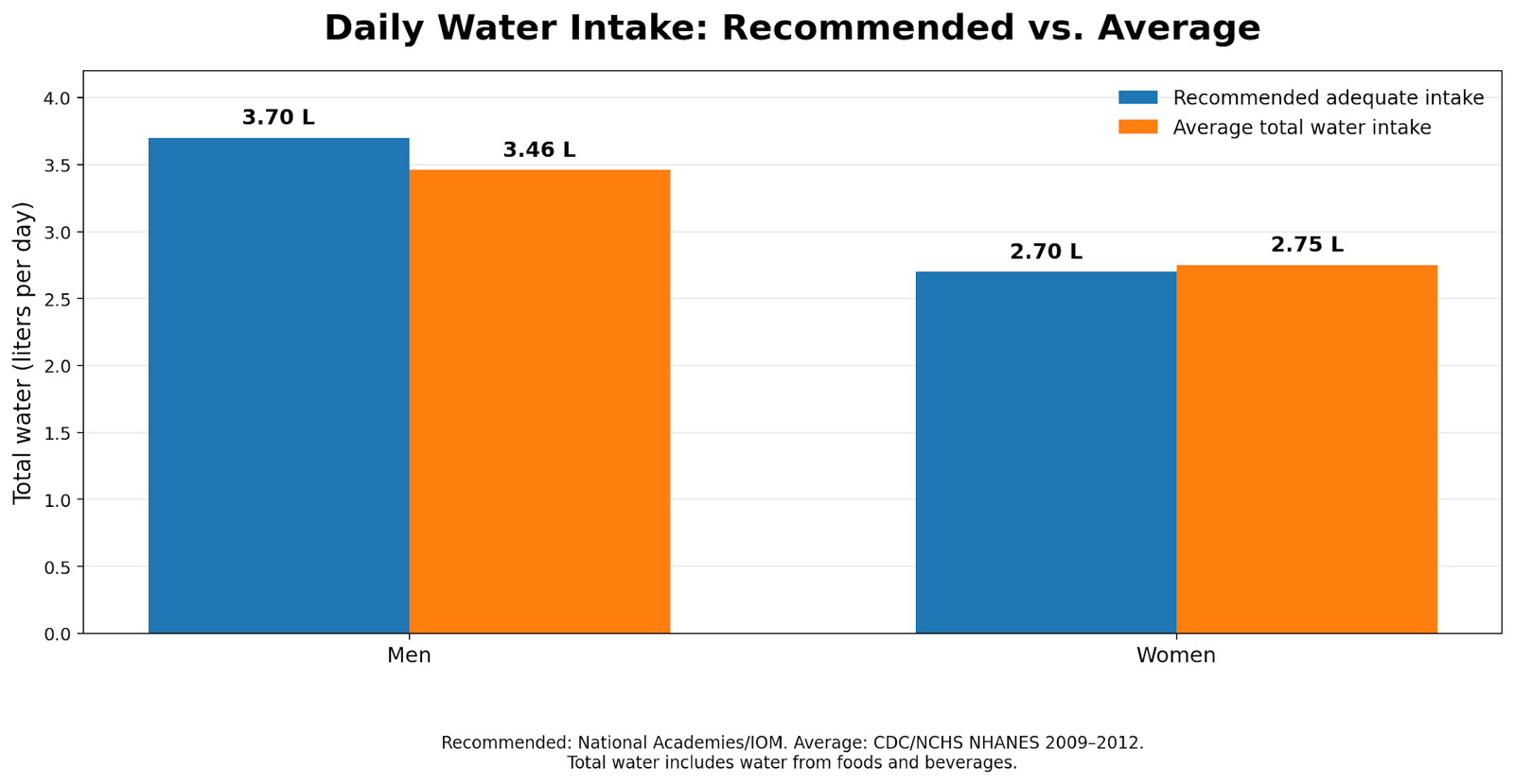
So when people ask how much water you should drink a day, they’re often surprised to learn the average American adult isn’t too far off already. A CDC data brief from 2009–2012 shows men average 3.46 liters of total water daily, and women hit roughly 2.75 liters—nearly matching the National Academies’ recommended intake. Interestingly, about a fifth of that moisture comes straight from food. That is basically why hydrating foods like melons, cucumbers and soups matter so much.
Read more: 8 Water-Rich Foods That Help You Stay Hydrated
What Actually Decides Your Number
There’s no one-size-fits-all formula for how much water you should drink a day for every single person on the planet. Bodies and routines and climates vary too much for a single figure to work for everyone. Someone working in a cool office all day needs a lot less fluid than someone doing daily exercise or manual labour outside in Louisiana in the dry season. Some things move the needle more than most people think.
- Body size and weight. Bigger bodies tend to hold and lose more fluid throughout the day
- Activity level, especially exercise, working with your hands, or anything that basically makes you sweat a lot
- An high altitude environment that is basically hot and humid can cause rapid fluid losses
- Health conditions like fever, vomiting and diarrhoea or certain medications that affect fluid balance
- Pregnancy and breastfeeding, both of which significantly raise the body’s baseline fluid requirements
- Diet, especially salty, protein-rich, or high fibre meals that pull more water into digestion
Signs You’re Not Getting Enough
Mild dehydration can be easy to ignore until it actually starts slowing you down. In one study, published in the British Journal of Nutrition, mild dehydration in healthy young men that is enough to cause a weight loss of just 1.5 to 1.6 percent, sufficiently led to a measurable reduction in reaction time, an impairment of working memory, and an increase in feelings of fatigue and tension. That’s a smaller fluid loss than most people would think has any noticeable effect, which is part of why hydration matters well before you actually feel thirsty.
What Mild Dehydration Looks Like | What Good Hydration Looks Like |
|---|---|
Darker urine, closer to amber | Pale straw colored urine |
Low energy or a nagging headache | Steady energy through the day |
Dry mouth or chapped lips | Comfortable, moist mouth |
Trouble focusing on simple tasks | Sharper, more consistent concentration |
Lightheadedness when standing up fast | No dizziness with sudden movement |
Read more: 12 Tips for Healthy Weight Loss
Practical Ways to Hit Your Number Without Obsessing Over It
You don’t need a spreadsheet to figure out how much water you should drink a day. A handful of small habits get most people most of the way there without much thought at all.
- Keep a reusable bottle somewhere you’ll actually see it, not buried in a bag
- Drink a glass with each meal instead of trying to save it all for later
- Add water rich foods like cucumber, watermelon, or a bowl of soup to your plate
- Check your urine color rather than counting exact ounces every hour
- Drink a little extra before and during exercise, especially in heat
- Set a couple of phone reminders if you genuinely tend to forget entirely
Common Mistakes People Make With Water Intake
The old eight glasses a day rule gets repeated so often that people treat it like settled science, but recent reports have noted this figure was never based on strong evidence to begin with. It’s a decent rough guideline, not a hard target carved in stone.
Another common mistake is assuming coffee and tea don’t count because they’re mildly diuretic. Research generally shows that moderate caffeine intake doesn’t cause a meaningful fluid deficit in regular drinkers, so your morning coffee still counts toward your total, even if plain water remains the better everyday default.
And a lot of people forget that when someone asks how much water should you drink a day, alcohol should basically be left out of that count entirely, since it works against hydration rather than for it, pulling fluid out of the body faster than it puts any back in.
Drink or Food | How It Counts Toward Hydration |
|---|---|
Plain water | Counts in full, the simplest and most reliable choice |
Coffee or tea | Still counts toward your total despite the mild diuretic effect |
Milk | Counts fully and adds protein and calcium along with it |
Broth or soup | Counts fully and brings useful electrolytes to the table |
Watermelon or cucumber | Counts substantially at roughly 90 to 96 percent water |
Beer, wine, or spirits | Doesn’t reliably count and can work against hydration |
Read more: 8 Best Workouts to Keep You Healthy
Final Thoughts: How Much Water Should You Drink A Day?
Figuring out how much water you should drink a day doesn’t have to be a math problem. Try to aim for somewhere in the 2.7 to 3.7 litre range depending on your gender, size and activity level. You’ll normally feel like drinking water everyday so lean on that range and let a few water rich foods pick up part of the slack. Pay attention to your energy, your urine colour, and how you feel by mid afternoon and adjust from there instead of chasing a number that was never in your specific plan from daybreak.
Frequently Asked Questions
Here are quick answers to the most common questions people ask on how much water should be consumed daily.
How much water do you need in a day?
Most healthy adults need roughly 2.7 to 3.7 liters of total water daily, about 11.5 cups for women and 15.5 cups for men, according to the National Academies, adjusted upward for activity, heat, pregnancy, or breastfeeding. Adequate daily hydration is essential to health, better energy, and best physical performance.
Does food count toward hydration?
Yes. Water-rich foods provide about 20% of your total daily water needs. Fruits and vegetables like watermelon, cucumbers, tomatoes, and strawberries have high water content that you will surely benefit from. Consuming these hydrated, fresh foods on a regular basis promotes good health and helps preserve ideal electrolyte balance while supporting optimal daily wellness goals.
Can you drink too much water?
Yes, though it’s uncommon. Water intoxication can overload the kidneys dangerously, causing the brain to swell, and this can be fatal and needs emergency medical treatment. Drinking excessive amounts in a short window can dilute sodium levels and cause hyponatremia. Spacing fluids throughout the day and following thirst cues keeps intake safe for almost everyone.
Related Contents:
- 8 Water-Rich Foods That Help You Stay Hydrated
- 12 Tips for Healthy Weight Loss
- 8 Best Workouts to Keep You Healthy
- The Complete Guide to Healthy Grocery Shopping
- Meal Prep for Weight Loss: The Complete Beginner’s Guide
- 7 Easy Ways To Improve Your Daily Fitness
- Top 20 Ways to Relieve Stress and Anxiety
- How Do Fitness Trackers Measure Calories Burned? Expert Analysis
- How to Stay Hydrated During Exercise: 7 Simple Tips
- How to Rehydrate Quickly After Exercise