
Written by: Segun Akomolafe
Let’s face it. Nobody ever sat you down in school and gave you a straight answer about how much money you actually need to save. You have probably heard “save more” your whole life but when you ask how much exactly? The room falls silent. But personal finance isn’t a one-size-fits-all equation, and the answer really depends on where you are, how much you make, and where you want to go.
The good news is there are solid, research-based guidelines that take the guesswork out. If you’re starting from scratch, or just want to sharpen a savings plan you already have, this guide walks you through exactly how much money you should save, and why those numbers actually make sense for building real financial security.
Quick Answer
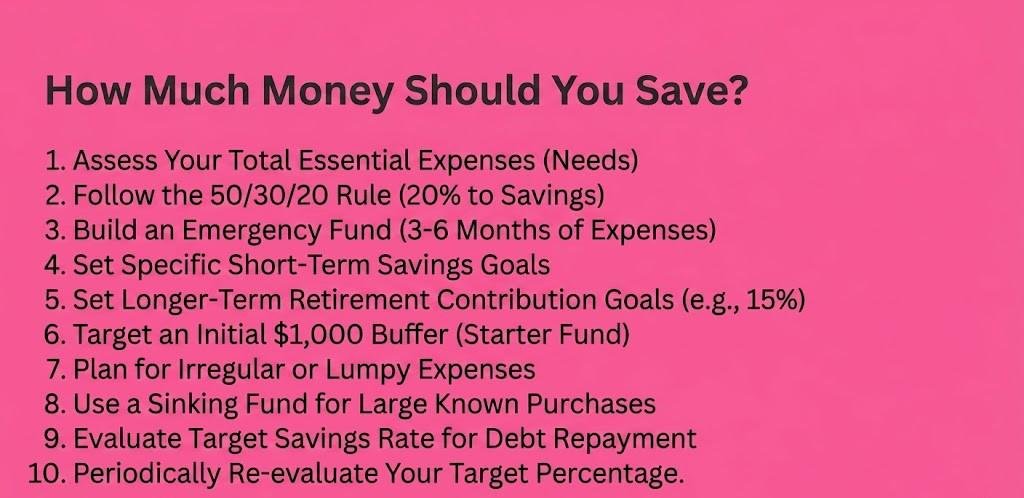
Most financial experts recommend saving 3–6 months of expenses as an emergency fund, around 10–15% of gross income for retirement and at least 20% of your take-home pay overall. If you’re just starting out, even 10% is a solid foundation. The right number depends on your income, expenses and goals, but having any consistent savings habit beats waiting until the amount feels “perfect.”
Why Financial Security Starts With a Number
Most people’s financial anxiety does not come from spending too much, it comes from not knowing if they have enough of a cushion. When you don’t have a savings target, every unexpected expense can feel like a crisis. Financial security, at its core, is about reducing that anxiety by building buffers that match your life’s risks.
So before you ask how much should you save? It’s good to first define what you’re saving for. The three core pillars of financial safety are your emergency fund, your retirement nest egg and your short-to-medium-term goal savings. Each one has a different recommended amount, and together, they form a complete financial safety net.
Here’s a quick overview of common savings goals and what’s typically recommended:
|
Goal |
Recommended Amount |
Timeline |
Priority Level |
|---|---|---|---|
|
Emergency Fund |
3–6 months of expenses |
6–18 months |
High — do this first |
|
Short-term goals (holiday, car) |
Dedicated savings bucket |
1–3 years |
Medium |
|
Retirement |
10–15% of gross income |
Decades |
High — start early |
|
Home down payment |
10–20% of property value |
3–7 years |
Medium-High |
Read more: Savings Vs. Investing: Which One Should You Choose?
The Emergency Fund — Your First Line of Defense
If you’re wondering how much money you should save first, the answer is almost always your emergency fund. Before you think about investing, before you tackle big financial goals, you need a buffer for life’s unpredictable moments like job loss, a surprise medical bill, a car repair that couldn’t wait.
The standard recommendation from financial planners is 3 to 6 months of living expenses, kept in an accessible, liquid account. That means if your essential monthly costs, rent, food, utilities, transport, total $2,500. Your emergency fund target is somewhere between $7,500 and $15,000.
But life isn’t uniform. A person with irregular income needs a bigger cushion than an employee with stable pay. A single parent carries more financial risk than a dual-income couple without dependents. That’s why your situation determines your number, not just a general rule.
Use this table to quickly identify the right emergency fund size for your situation:
|
Situation |
Recommended Fund Size |
Why It Matters |
|---|---|---|
|
Single income, no dependents |
3 months of expenses |
Lower risk exposure |
|
Dual income, no dependents |
3 months of expenses |
Shared buffer reduces individual risk |
|
Single income, with dependents |
6 months of expenses |
Higher stakes if income stops |
|
Self-employed / freelance |
6–12 months of expenses |
Irregular income needs bigger cushion |
Once your emergency fund is fully stocked, you’ll feel a genuine shift in how you experience money. You stop reacting and start planning. That’s one of the most underrated benefits of how much money you need to save for financial safety — it’s not just a number, it’s peace of mind.
Read more: Debt Snowball vs Avalanche Method: Which Pays off Debt Faster?
The 50/30/20 Rule — A Practical Starting Point
One of the most popular frameworks in personal finance for deciding how much to save for financial security is the 50/30/20 rule. It’s simple enough to use immediately but flexible enough to adapt to almost any income level.
Here’s how it breaks down:
- 50% of your after-tax income goes toward needs — rent or mortgage, food, utilities, healthcare, and minimum debt payments.
- 30% goes toward wants — dining out, entertainment, subscriptions, vacations, and anything that improves your quality of life beyond the basics.
- 20% goes toward savings and debt repayment — and this is where your emergency fund, retirement contributions, and other goals get funded.
That 20% is the real engine of financial security. At a $4,000 take-home monthly income, 20% equals $800 every single month going toward your future. Over a year, that’s $9,600 — which alone could fully fund your emergency fund in less than two years.
Now, not everyone can hit 20% right away, and that’s okay. Even starting at 10% and gradually increasing as your income grows or your expenses shrink is a meaningful win. The key is consistency — saving something every month matters far more than saving a perfect amount occasionally.
Read more: A Deep Dive Into Secured vs. Unsecured Loan
How Much Should You Save by Income Level?
Percentages are great in theory, but real people think in dollars. So, here’s an optimized table of details that directly answers the question of how much you should save?
|
Monthly Income |
Minimum Save (10%) |
Healthy Save (20%) |
Aggressive Save (30%) |
|---|---|---|---|
|
$2,000 |
$200 |
$400 |
$600 |
|
$3,500 |
$350 |
$700 |
$1,050 |
|
$5,000 |
$500 |
$1,000 |
$1,500 |
|
$8,000+ |
$800 |
$1,600 |
$2,400+ |
A few things stand out here. First, even at a $2,000 monthly income, saving $200 to $400 a month is both achievable and genuinely impactful. Second, the gap between minimum and aggressive saving is dramatic at higher income levels — which is why income growth, when paired with controlled lifestyle inflation, can supercharge your savings rate over time.
Here’s a nuance worth knowing: personal finance experts generally agree that the savings rate matters more than the raw dollar amount. Someone saving 25% of a modest income is often in a stronger financial position long-term than someone saving 8% of a high income and spending everything else.
Read more: Best Bank Bonuses and Promotions in the US
Retirement Savings — The Long Game You Can’t Ignore
If you’re asking how much money should you save for the long term? Retirement is where the biggest numbers live. The widely accepted rule of thumb is to save 10–15% of your gross income for retirement, starting as early as possible. The reason is for compound interest. Money invested in your 20s grows exponentially compared to the same money invested in your 40s.
Let’s make that concrete. If you start saving $300 a month at age 25 with an average 7% annual return, you’d have roughly $900,000 by age 65. Start at 35 with the same amount, and you’re looking at closer to $450,000 — roughly half the outcome for the same monthly effort. This makes it clear that it’s better to start saving early.
For those with employer-sponsored retirement plans like a 401(k), financial advisors strongly recommend contributing at least enough to capture the full employer match. That’s essentially free money — not using it is one of the most common costly personal finance mistakes people make.
If retirement accounts aren’t available through your employer, individual retirement accounts (IRAs) are the next best option. For 2025, you can contribute up to $7,000 annually to a traditional or Roth IRA — or $8,000 if you’re 50 or older.
Read more: How to Invest Early: 7 Strategies for Better ROI
What If You’re Starting Late? Honest Advice for Every Stage
Many reports on how much to save for financial security assume you started at 22 with a full-time job and zero debt. The real world isn’t that tidy. If you’re in your 30s or 40s and feeling behind, you’re not alone — and you’re not out of options.
Starting late just means you need to be more intentional. Here’s what actually works when you’re playing catch-up:
- Increase your savings rate faster — rather than saving 20%, aim for 25–30% if your income allows. The math won’t be as comfortable as starting early, but it still makes a significant difference.
- Take advantage of catch-up contributions — once you’re 50 or older, the IRS allows extra contributions to retirement accounts beyond the standard limits.
- Cut lifestyle inflation aggressively — as your income grows, resist the urge to upgrade your lifestyle at the same pace. Redirecting raises directly into savings can accelerate your timeline dramatically.
- Reduce high-interest debt first — carrying 20%+ APR credit card debt while trying to save is counterproductive. Eliminating that debt is effectively a guaranteed 20% return on your money.
- Explore income growth opportunities — side income, freelance work, or career development investments can increase the total money available to save.
Starting late is real, but stopping entirely is the only true financial mistake. Even building a $15,000 emergency fund in your 40s puts you significantly ahead of millions of adults who have nothing set aside.
The Psychology of Saving — Why Automating Works
Simply asking how much money should you save? doesn’t automatically lead to actually saving it. The gap between knowledge and action in personal finance is huge — and it’s largely psychological.
The most effective strategy most financial coaches recommend? Automate everything. Set up an automatic transfer to your savings account the same day your paycheck arrives. When the money never hits your checking account, you don’t miss it. Your brain adapts to the slightly smaller spending amount, and saving becomes frictionless.
Here’s the truth about willpower: it’s a limited resource. Relying on yourself to manually transfer savings every month introduces friction, and friction kills habits. Automation removes that friction entirely. This optimizes wealth accumulation while protecting your retirement portfolio from costly human error and emotional spending.
A good savings tip that has worked for many successful people is the name method. Give your savings accounts specific names — “Emergency Fund,” “House Down Payment,” “Trip to Japan.” Research in behavioral economics shows that labeling savings for a specific purpose increases your commitment to not touching it. It’s a small trick, but it works.
Read more: 15 Best Online Banks For Reliable Savings
Setting Milestones That Keep You Motivated
Saving is a long game and long games require checkpoints. Don’t just track progress toward your ultimate goal. Celebrate the mini-goals along the way. This includes your first $1,000 saved, your first month of expenses covered, your first $10,000 in the bank. These moments reinforce the behavior and keep you from feeling like the finish line is impossibly far away. Build an emergency fund and improve your personal finance habits for long-term financial security with these smart savings strategies.
Frequently Asked Questions
Here are the most effective answers to the most common questions people ask globally concerning how much they should actually save for financial security.
How much money should you really save every month as a beginner?
Start with at least 10% of your take-home pay. By building a solid emergency fund first, you avoid high-interest debt and protect yourself against unexpected financial emergencies. Automate it immediately. As your income grows or expenses shrink, increase toward 20% for meaningful, compounding financial progress over time. Using budgeting apps and automating high-yield savings accounts builds smart financial habits, ensures long-term wealth stability and accelerates early retirement planning.
Is saving 20% of your income actually enough for long-term financial security?
Yes, for most, if you begin early, by building a diversified portfolio of stocks and bonds. This is basically important when combined with strict budgeting and high-yield savings accounts to maximize your ultimate growth potential. Getting this finance milestone can help you build wealth through compound interest and set yourself up on a path for an early retirement. Saving 20% consistently over two to three decades, invested wisely, builds both an emergency cushion and a solid retirement fund with reasonable returns.
What’s the biggest mistake people make when trying to save money?
Not automating. People who manually transfer savings each month miss too often. By missing these important monthly contributions, you severely stunt your long-term compound interest growth and affect your future financial security. Setting automatic transfers on payday removes the decision entirely, making consistent saving dramatically more reliable and effective. Building a reliable emergency fund and securing your financial independence requires strict adherence to a disciplined approach.
Related Contents:
- How to Create a Debt-Free Budget: 5 Key Strategies
- Savings Vs. Investing: Which One Should You Choose?
- Debt Snowball vs. Avalanche Method: Which Pays Off Debt Faster?
- How to Improve Your Credit Utilization Ratio?
- How to Payoff Your Most Important Bills First: A Step-by-Step Priority Guide
- 15 Best Online Banks For Reliable Savings
- How to Invest Early: 7 Strategies for Better ROI
- Best Bank Bonuses and Promotions in the US
- How to Live Within Your Means
- 7 Smart Savings Tips Everyone Should Know