
Written by: Segun Akomolafe
Let’s be real, if you can’t measure your results, you’re just guessing. And in affiliate marketing, guessing is a fast road to burned budgets and missed opportunities. Understanding how to measure affiliate marketing ROI is the difference between scaling a profitable program and throwing money at links that go nowhere.
This guide walks you through every metric, formula and tools you need to track performance properly, without the fluff. Whether you’re a merchant running a program or a publisher trying to prove your value, you’ll find something useful here.
Quick Answer
To measure affiliate marketing ROI, use the formula: ROI (%) = ((Revenue − Total Costs) ÷ Total Costs) × 100. Track costs (commissions, fees, content) against affiliate-attributed revenue. Optimizing this digital marketing metric improves profitability. Most programs target 3:1 to 10:1 returns. Pair ROI with CTR, conversion rate, EPC and CPA, and set up UTM tracking plus GA4 goals for accurate attribution.
What Is Affiliate Marketing ROI?
ROI — return on investment — tells you how much money you made relative to how much you spent. In affiliate marketing, that calculation covers your commissions, platform fees, creative costs, and any other overhead cost.
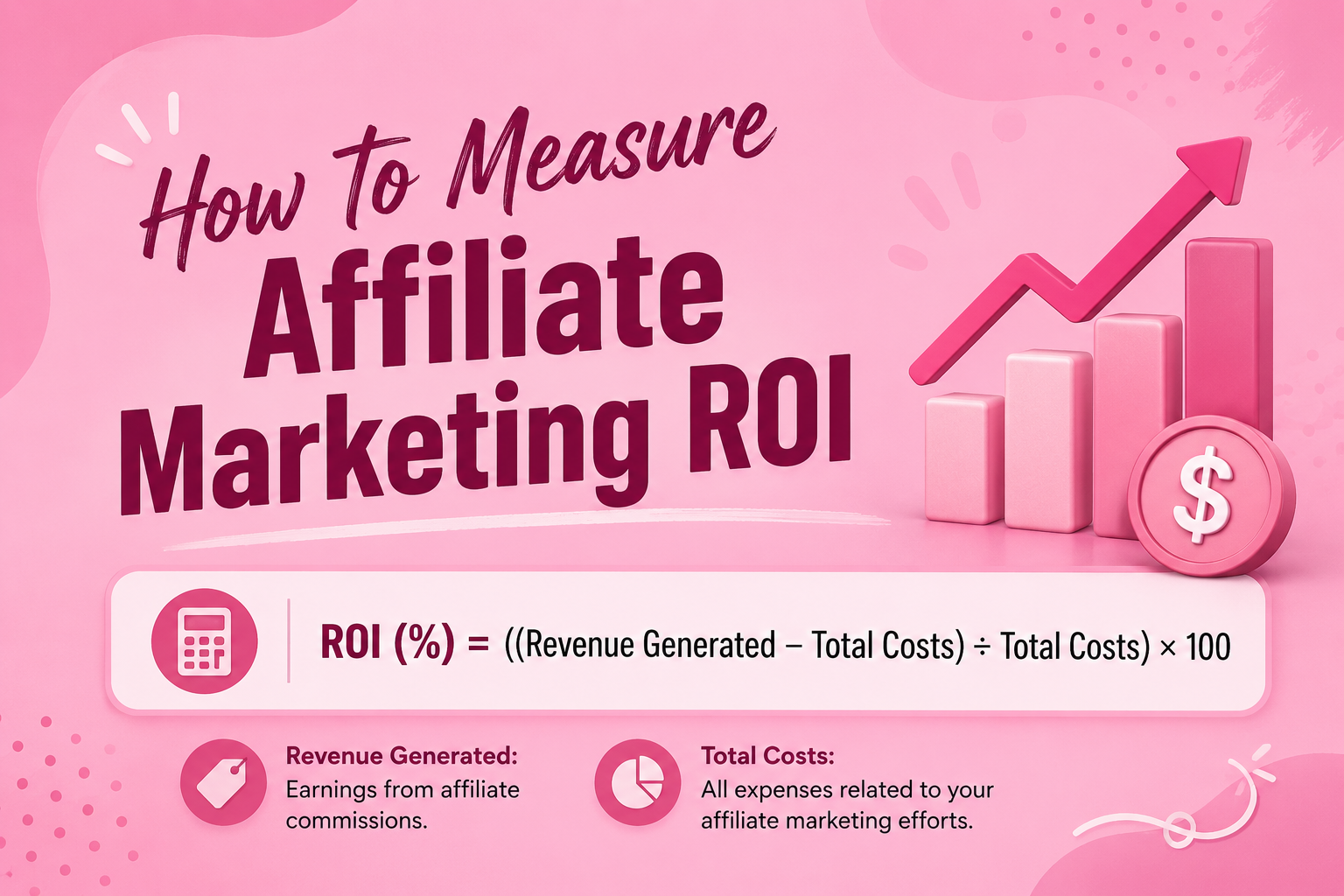
The basic formula for how to measure affiliate marketing ROI is shown in the image above and it’s simple:
ROI (%) = ((Revenue Generated − Total Costs) ÷ Total Costs) × 100
Say you spent $2,000 on your affiliate program in a month (commissions + platform fees), and those affiliates drove $8,000 in revenue. Your ROI is 300%. That’s a good program. Most brands aim for at least 3:1, meaning three dollars earned for every dollar spent.
But raw ROI is only part of the story. You also need to track the granular metrics beneath it. This is because knowing your program made money doesn’t tell you which affiliates, channels, or content types actually drove that result.
Read More: Affiliate Marketing For Beginners Explained: How It Works Step by Step
Key Metrics You Need to Track
Measuring ROI in affiliate marketing isn’t a single number, it’s a dashboard of indicators working together. Here’s what actually matters:
- Click-through rate (CTR): The percentage of people who click your affiliate link after seeing it. Low CTR usually signals a placement or copy problem.
- Conversion rate (CR): Of the people who clicked, how many completed the target action (purchase, signup, contact etc.)? Industry average is around 1–5%, though it varies widely by niche.
- Average order value (AOV): Higher AOV means more commission per conversion. Some affiliates drive lots of small sales; others fewer but bigger ones.
- Cost per acquisition (CPA): What you paid (in commissions) to acquire one customer. Compare this to your customer LTV to see if the math works.
- Earnings per click (EPC): Total commissions divided by total clicks. A universal benchmark that lets you compare one program or affiliate against another.
- Revenue per affiliate: Which of your partners are actually pulling weight? This surfaces your top 20% who often drive 80% of results.
- Incremental revenue: The revenue you’d have missed without the affiliate channel. This is the hardest to measure but the most valuable.
Table 1: Core Affiliate Marketing Metrics at a Glance
|
Metric |
Formula |
What It Tells You |
|---|---|---|
|
ROI |
((Revenue − Cost) ÷ Cost) × 100 |
Overall profitability of the program |
|
CTR |
(Clicks ÷ Impressions) × 100 |
How compelling your link placement is |
|
Conversion Rate |
(Conversions ÷ Clicks) × 100 |
Quality of traffic affiliates send |
|
CPA |
Total Spend ÷ Conversions |
Cost to acquire one customer |
|
EPC |
Total Commissions ÷ Total Clicks |
Earnings efficiency per click |
|
AOV |
Total Revenue ÷ Number of Orders |
Average value of each completed sale |
Read More: How to Measure Influencer Marketing ROI
How to Set Up Proper Tracking
You can’t measure what you’re not tracking. Good tracking is the foundation of understanding how to measure affiliate marketing ROI and it doesn’t have to be complicated to get right.
Use UTM Parameters
UTM parameters are tags you append to your affiliate URLs that pass data into Google Analytics. Set up utm_source (the affiliate or network), utm_medium (affiliate), and utm_campaign (the specific promotion). Ensure you maintain a clean and consistent naming convention, and always test your final tagged URLs to prevent misattributed or lost data. This lets you filter your analytics by affiliate traffic and see exactly which campaigns drive conversions.
Set Up Goal Tracking in GA4
In Google Analytics 4, configure conversion events for purchases, signups, or whatever action defines success for your program. Once set up, you can segment these conversions by traffic source, including your affiliate UTM tags, and pull revenue data per channel.
Leverage Your Affiliate Network’s Dashboard
Most affiliate networks (ShareASale, Impact, Partnerstack, CJ) come with built-in reporting that covers clicks, conversions, commissions and EPC by affiliate. Don’t ignore these dashboards, they’re often the most direct source of truth for affiliate-specific data.
Consider Multi-Touch Attribution
Last-click attribution is the default in most programs, but it’s not always fair or accurate. A customer might see a website review, click a YouTube affiliate link, then search directly and convert. That final click gets all the credit, but the blog started the journey. Multi-touch models (linear, time-decay, data-driven) distribute credit across the whole journey and give you a clearer picture of what’s actually driving decisions.
Read More: How to Measure Digital Marketing Success: Essential Metrics and Analytics Guide
How to Calculate Your Affiliate Program ROI Step by Step
If you’re serious about understanding how to measure affiliate marketing ROI, walk through this process at least once a month:
Step 1: Add Up All Your Costs
This includes paid commissions, affiliate network fees (typically 20% – 30% above the commission), any expenses for content or creativity, and the management time of the program. You also need to take into account organic traffic investments that will help satisfy the search intent of the users and improve Your E-E-A-T.
Step 2: Calculate Gross Revenue from Affiliates
Pull your affiliate-attributed revenue from your network dashboard or analytics platform for accurate financial tracking and better profit analysis. Use the same time window as your costs. If you’re running a SaaS business, include recurring revenue from affiliate-referred subscribers to measure true channel profitability.
Step 3: Apply the ROI Formula
Plug your numbers into: ROI = ((Revenue − Costs) ÷ Costs) × 100. A 200% ROI means you tripled your investment. A 50% ROI means you made 1.5× back, decent depending on your LTV. Anything below 100% (less than breaking even on the affiliate-sourced revenue) needs immediate attention. Monitor the following metrics associated with affiliate marketing through your analytics dashboard to improve your digital marketing strategy and increase profits.
Step 4: Segment by Affiliate and Channel
Don’t stop at the program-level number. Break it down by individual affiliate, traffic source, content type, and promotion period. You’ll often find that 20–30% of affiliates drive 70–80% of ROI. Scale those relationships. Cut or mentor the underperformers.
Table 2: Example ROI Calculation for a Mid-Size Affiliate Program
|
Line Item |
Amount (USD) |
|---|---|
|
Total Commissions Paid |
$3,200 |
|
Network/Platform Fees (25%) |
$800 |
|
Creative & Management Costs |
$400 |
|
Total Program Costs |
$4,400 |
|
Total Revenue Attributed |
$18,700 |
|
Net Profit |
$14,300 |
|
ROI |
325% |
Read More: How to Start Affiliate Marketing While Growing Your Audience
Common Mistakes That Skew Your ROI Data
Even experienced programs make errors when calculating how to measure affiliate marketing ROI. Here’s what distorts the numbers:
- Counting gross revenue instead of net: Refunds, chargebacks, and taxes reduce your actual revenue. Always use net revenue in your ROI calculations.
- Ignoring the cookie window effect: Conversions attributed to affiliates may include customers who were already in your funnel. Without a control group or incrementality test, you might be double-counting.
- Not accounting for cannibalization: Some affiliates, especially coupon and loyalty sites, capture sales that would have happened anyway. High volume doesn’t always mean high incrementality.
- Confusing correlation with causation: A traffic spike during an affiliate campaign doesn’t always mean the campaign caused it. External factors (seasonality, PR, product launches) can inflate affiliate attribution.
- Skipping LTV analysis: A customer who buys once at $40 is worth less than one who subscribes at $20/month for two years. ROI looks different when you factor in lifetime value.
Read More: How Affiliate Links Work: The Complete Beginner-to-Pro Guide
Tools to Help You Measure Affiliate Marketing ROI
You don’t have to build a custom analytics stack from scratch. These tools handle the heavy lifting:
Table 3: Top Tools for Measuring Affiliate Marketing ROI
|
Tool |
Best For |
Key Feature |
|---|---|---|
|
Google Analytics 4 |
Traffic & conversion attribution |
Multi-touch attribution models, UTM tracking |
|
Impact Radius |
Large affiliate programs |
Advanced fraud detection, granular partner reporting |
|
ShareASale |
SMB programs across retail niches |
Real-time click and commission dashboards |
|
Partnerstack |
SaaS and B2B affiliate programs |
Automated payouts, multi-tier commission support |
|
Voluum |
Media buyers & performance marketers |
A/B testing for landing pages, path analysis |
|
Everflow |
Enterprise programs needing granularity |
Incrementality testing, multi-attribution support |
Read More: How to Grow Your Audience With Affiliate Marketing
Improving ROI Once You’ve Measured It
Knowing how to measure affiliate marketing ROI is only useful if you act on the data. Here’s where to focus once the numbers are in:
Start with your top performers. Look at your top 10 affiliates by EPC and find patterns, same niche, same content type, same audience segment? Do a keyword gap analysis too. Focus on high converting transactional queries to improve search visibility and sustain long term organic traffic. Replicate those conditions. Offer better commission tiers or exclusive promotions to keep high-ROI partners engaged.
Then prune or retrain the underperformers. A partner generating lots of clicks but near-zero conversions is either sending mismatched traffic or creating poor context around the link. Reach out, review their content, and offer guidance, or pause the partnership.
Test commission structures. Sometimes shifting from flat-fee CPA to revenue share (or vice versa) changes affiliate behavior dramatically. If your AOV varies widely, tiered commissions that reward higher-value sales can improve overall program ROI without increasing spend.
Read More: What is Digital Marketing?
Understanding Incrementality: The Gold Standard Metric
If you want to learn how to measure affiliate marketing ROI, you can’t just stop at last-click attribution. You need to understand incrementality and that’s the revenue you would have lost without affiliates altogether. Mastering this vital analytics strategy helps you optimize digital ad spend, eliminate wasted budget and accurately prove true campaign performance.
The simplest way to test this is a holdout test: for a defined period, stop affiliate traffic to a randomly selected control group of your audience and compare conversion rates against the group still exposed to affiliates. The delta is your incremental lift.
This matters because some affiliate channels, particularly coupon sites and loyalty programs have very high attributed revenue but very low incrementality. They’re capturing conversions that would have happened anyway, just with a discount code applied. That’s not bad per se (it can reduce cart abandonment), but it inflates your apparent ROI substantially.
Running incrementality tests quarterly gives you a much more accurate picture of the true value your affiliate program delivers — and it’s the kind of rigorous measurement that earns buy-in from CFOs and leadership teams.
Read More: Influencer Marketing You Need To Know
Frequently Asked Questions
Here are honest answers to the most common questions users ask on how to measure affiliate marketing ROI.
1. How often should I measure affiliate marketing ROI?
At minimum, review your affiliate ROI monthly. For high-volume programs or active promotions, weekly check-ins help you catch underperforming partners and adjust commissions before losses compound. With such a system in place, you can measure your return on investment from all the campaigns, traffic sources and types of content. This is particularly significant in enhancing affiliate marketing ROI. Consistently monitoring these metrics ensures maximum profitability and long-term success. Auditing your data through analytics software such as Google Analytics to track key performance indicators will help you to recognize the high-converting organic search traffic that generates maximum profit.
2. What’s a good ROI benchmark for affiliate programs?
Most successful programs target a 3:1 to 10:1 revenue-to-cost ratio. E-commerce averages 4:1, while SaaS programs with strong LTV often exceed 8:1 due to recurring commission structures. To optimize these returns, carefully track conversion rates, eliminate commission leakage and prioritize high-intent organic search traffic. Whereas the return varies immensely depending on the nature of the business and type of traffic, the industry standard return expectation for every dollar invested is $6.50 (650% Return On Investment). Premium services and SaaS have the potential to generate between 10x to 15x, whereas the average retail return is estimated to be at 3x to 5x.
3. Can I measure affiliate ROI without expensive software?
Yes — Google Analytics 4 with UTM parameters and your network’s native dashboard covers most needs. This setup reliably aligns with your target audience’s search intent, ensuring consistent organic visibility. Paid tools add depth but aren’t mandatory for accurate affiliate ROI measurement at the start. Precise analytics can help you improve the ROI of your affiliate marketing campaigns and keep data-driven growth tracking affordable. Track exact clicks, conversions and revenue per partner to get actionable insights that boost profitability without spending money on expensive third-party tools.
Read More: Micro-Influencers vs. Mega-Influencers: Which Delivers Better ROI?
Final Thoughts
A good knowledge of how to measure affiliate marketing ROI isn’t about obsessing over dashboards; it’s about making smarter decisions with the data you already have. Set up proper tracking, know your key metrics, calculate ROI monthly, test incrementality quarterly, and keep optimizing based on what the numbers actually tell you.
The programs that scale are the ones where the manager knows which affiliates drive genuine growth, which ones are coasting on attribution, and how to invest commissions where they matter most. That kind of clarity doesn’t come from guesswork — it comes from a solid, repeatable measurement system.
Build it once. Consistently track performance metrics and optimize your digital marketing funnel. Refine it as you grow. The ROI on that investment in measurement pays for itself very quickly.
Related Contents:
- Influencer Marketing You Need To Know
- Affiliate Marketing For Beginners Explained: How It Works Step by Step
- The Ultimate Guide to Growing Your Online Business
- How to Grow Your Audience With Affiliate Marketing
- The 4 Best AI Apps For Marketers
- How to Measure Influencer Marketing ROI
- What is Digital Marketing?
- How to Start Affiliate Marketing While Growing Your Audience
- Micro-Influencers vs. Mega-Influencers: Which Delivers Better ROI?