
Written by: Segun Akomolafe
To be honest. Most of us have thought about how to save money properly. School covers algebra and history, but smart savings tips that actually change your financial life? Those you’re usually left to figure out on your own. And that gap costs people thousands of dollars every year.
Here’s the thing: saving money doesn’t have to mean eating plain rice and cutting out everything enjoyable. Done right, it’s about working smarter with what you already have. Whether you’re starting from zero or just feel like your savings aren’t going anywhere, these seven strategies will give you a clear, practical foundation to build real financial momentum.
Quick Answer
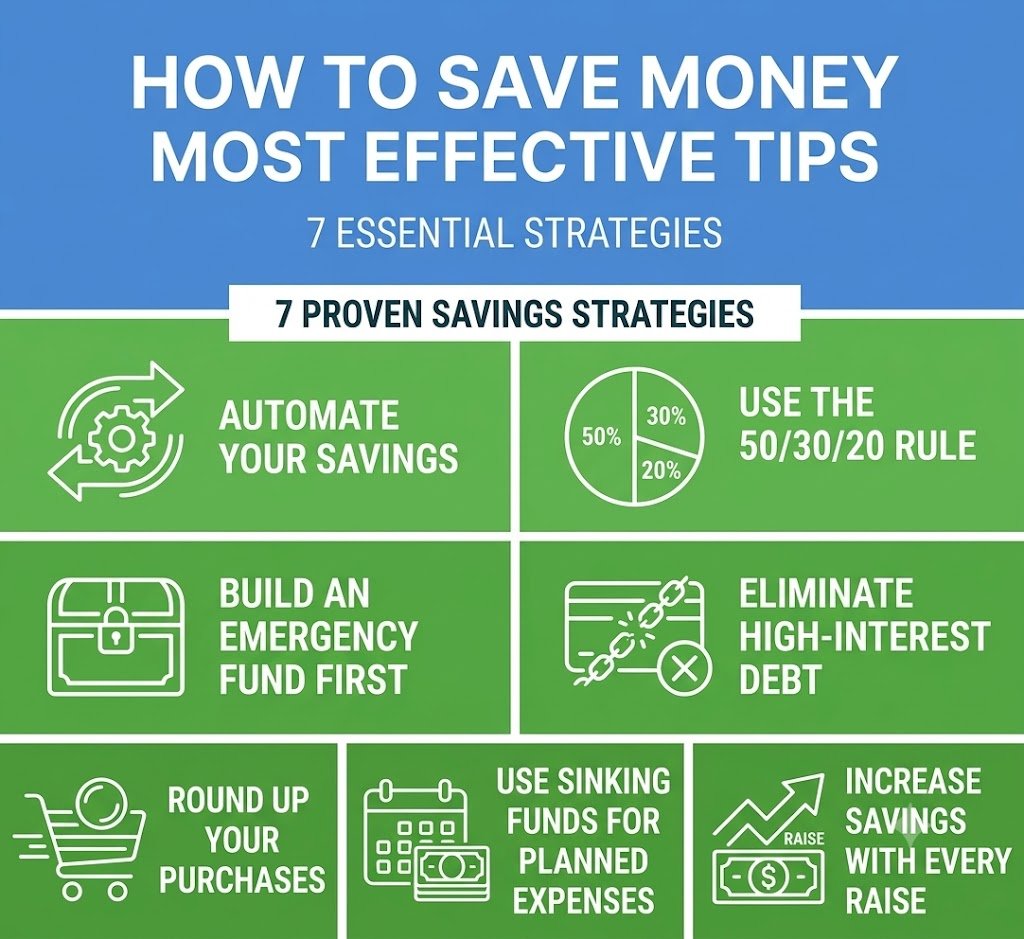
The most effective savings tips are: automate your savings, use the 50/30/20 rule, build an emergency fund first, eliminate high-interest debt, round up purchases, use sinking funds for planned expenses, and increase your savings rate with every raise. Consistency matters more than the dollar amount. Start small, stay steady, and grow over time.
1. Automate Your Savings — Remove Willpower From the Plan
Here’s one of the most underrated savings tips you’ll ever hear: stop relying on willpower. Willpower is a limited resource, and it’s going to lose to a craving, a sale, or just a really long day at work. Automation wins instead.
Set up an automatic transfer to your savings account on the same day your paycheck hits. Not two days later. Not when you’ve ‘seen how much is left.’ The same day. When the money bypasses your checking account entirely, your brain recalibrates to the smaller available balance and you simply adapt. It’s not magic, it’s just behavioral economics at work.
Even $50 or $100 per paycheck adds up fast. At $100 bi-weekly, you’ll have $2,600 saved without ever making a conscious decision to do so. Pair that with a high-yield savings account, and your money is quietly earning interest while you go about your life.
Read More: Savings Vs. Investing: Which One Should You Choose?
2. Use the 50/30/20 Rule to Instantly Organize Your Money
If you’ve never had a budget before, the 50/30/20 rule is genuinely your best place to start. It’s one of those savings tips that’s simple enough to implement today but structured enough to make a real difference over time.
Here’s the breakdown: allocate 50% of your after-tax income toward needs (rent, groceries, utilities, transport), 30% toward wants (entertainment, dining out, subscriptions), and 20% toward savings and debt repayment. That 20% slice is where your financial security actually gets built.
At a $3,500 monthly take-home, that’s around $700 going to savings every single month. Over a year, that’s $8,400, which is enough to fully fund a starter emergency fund and start building toward long-term goals. The rule isn’t perfect for everyone, but it’s a strong default that beats having no framework at all.
Table 1: Popular Savings Methods Compared
|
Savings Method |
Best For |
Avg. Monthly Save |
Difficulty |
|---|---|---|---|
|
50/30/20 Rule |
Salaried employees |
20% of income |
Easy |
|
Pay-Yourself-First |
All income types |
10–25% of income |
Easy |
|
Zero-Based Budget |
Detail-oriented people |
Varies |
Moderate |
|
Envelope System |
Cash spenders |
Variable |
Moderate |
|
Round-Up Savings |
Beginners |
$30–$80/month |
Very Easy |
Read More: How to Create a Debt-Free Budget: 5 Key Strategies
3. Build Your Emergency Fund First — Everything Else Follows
Before you think about investing, before you start planning vacations or paying down extra on your mortgage, you need an emergency fund. This is one of the foundational money-saving tips that financial planners repeat because it genuinely changes how stable your financial life feels day-to-day.
The standard goal is three to six months of living expenses, kept in a liquid, easily accessible savings account. If your monthly expenses are $2,000, your target is $6,000 to $12,000. That’s it. Not complicated, but transformative.
Why is this so important? If you don’t have that safety net, every surprise expense like a medical bill, a blown alternator, a sudden job loss forces you to reach for a credit card. And 20%+ APR credit card debt is stealthily killing your wealth. An emergency fund is what turns a crisis into a manageable inconvenience.
Table 2: Emergency Fund Targets by Life Situation
|
Your Situation |
Recommended Fund Size |
Monthly Savings Target |
|---|---|---|
|
Single income, no dependents |
3 months of expenses |
$200–$400 |
|
Dual income household |
3 months of expenses |
$300–$500 |
|
Single income + dependents |
6 months of expenses |
$400–$700 |
|
Freelance / self-employed |
6–12 months of expenses |
$500–$900 |
Signs your emergency fund is working for you:
- You didn’t need to swipe a credit card when your car broke down last month
- Unexpected medical co-pays no longer derail your entire month’s budget
- You sleep better knowing a job loss wouldn’t immediately become a crisis
- You can take a calculated career risk because you have a financial cushion
- You stopped living paycheck to paycheck even though your income hasn’t changed
Read More: Debt Snowball vs Avalanche Method: Which Pays off Debt Faster?
4. Tackle High-Interest Debt Aggressively — It’s Costing You More Than You Think
Carrying high-interest debt while trying to save is like filling a bathtub with the drain open. One of the most effective personal finance tips for saving money is to treat high-interest debt repayment as an investment with a guaranteed return. Paying off a 22% APR credit card balance is effectively a 22% return on your money, no stock market comes close to guaranteeing that.
There are two popular approaches: the debt avalanche method (attacking the highest interest rate first to minimize total interest paid) and the debt snowball method (paying off the smallest balance first for psychological wins). Both work. Pick the one you’ll actually stick to.
The key insight here is sequencing. Get your starter emergency fund to $1,000 first. Then go hard on high-interest debt. Once that’s cleared, return to building your full emergency fund and then redirect that freed-up monthly payment straight into savings. It’s a momentum strategy, and it really works.
Read More: How to Improve Your Credit Utilization Ratio?
5. Use Sinking Funds — Stop Letting Predictable Expenses Surprise You
A sinking fund is a small dedicated savings pool for a specific, planned expense. It’s one of the savings tips that sounds overly simple but completely eliminates the financial stress around known future costs like car insurance, holiday gifts, annual subscriptions, back-to-school supplies, or a vacation you’ve been planning.
Here’s how it works: if you know you’ll spend $600 on holiday gifts in December, set aside $50 every month starting in January. By the time December arrives, you’ve already got it covered — and you never had to put it on a credit card or scramble at the last minute.
The beauty of sinking funds is they convert big, lump-sum expenses into small, manageable monthly contributions. Most high-yield savings accounts allow multiple sub-accounts or ‘buckets,’ so you can label each one and watch it grow without commingling funds. Apps like YNAB (You Need A Budget) or Ally Bank’s buckets feature make this effortless.
Common expenses worth creating sinking funds for:
- Annual car insurance or registration fees
- Holiday and birthday gifts (budget this out monthly, not in December)
- Home maintenance and appliance repair fund
- Travel and vacation expenses
- Medical deductibles and dental work
- Back-to-school or annual subscription costs
Read More: How to Payoff Your Most Important Bills First: A Step-by-Step Priority Guide
6. Round Up Your Purchases — Small Change, Big Results Over Time
This is one of the best savings tips for beginners because it requires almost zero effort and creates real savings without feeling like sacrifice. Many banks and fintech apps (Acorns, Chime, Bank of America’s Keep the Change) automatically round up every debit card purchase to the nearest dollar and funnel the difference into a savings or investment account.
A $4.30 coffee becomes $5.00, and that $0.70 goes straight to savings. Doesn’t sound like much? The average person who rounds up consistently accumulates between $300 and $600 per year in completely passive savings. It’s not a retirement strategy, but it’s a genuinely painless way to start building a habit and watch a number grow.
The real value isn’t the amount — it’s the behavior it builds. Once you see a savings account grow, even slowly, you get motivated to contribute more intentionally. Round-up savings is often the gateway habit that leads people to more aggressive, intentional saving.
Table 3: Monthly Savings Targets by Income and Rate
|
Monthly Take-Home |
Save 10% (Starter) |
Save 20% (Healthy) |
Save 30% (Aggressive) |
|---|---|---|---|
|
$1,500 |
$150 |
$300 |
$450 |
|
$2,500 |
$250 |
$500 |
$750 |
|
$4,000 |
$400 |
$800 |
$1,200 |
|
$6,000 |
$600 |
$1,200 |
$1,800 |
|
$8,000+ |
$800+ |
$1,600+ |
$2,400+ |
Read More: 15 Best Online Banks For Reliable Savings
7. Increase Your Savings Rate With Every Raise — Fight Lifestyle Inflation
Most people who struggle to save aren’t bad with money, they’ve just been caught by lifestyle inflation. Every raise brings a nicer car, a bigger apartment, or more frequent dining out, and somehow the bank account never actually grows. This is one of the most powerful savings tips because it reframes how you think about income growth entirely.
The rule is simple: when you get a raise, save at least half of it. If your take-home increases by $400 a month, direct $200 straight to savings before you ever adjust your lifestyle to accommodate it. Your lifestyle stays the same, but your savings rate climbs steadily year over year.
This strategy compounds powerfully over time. Someone who earns modest income increases but consistently saves a growing percentage will often outpace someone with a high income who treats every raise as permission to spend more. It’s not about how much you earn — it’s about how much of it you keep. These smart savings tips work precisely because they run on systems, not motivation.
Read More: How to Invest Early: 7 Strategies for Better ROI
Why Most People Struggle to Save — And What Actually Changes It
It’s worth being honest about why saving is hard. It’s not usually a knowledge problem — most people have heard most of these tips for saving money effectively. The real gap is behavioral. Here are the three most common barriers and how to actually address them:
The ‘I’ll save what’s left’ mindset. If you wait until the end of the month to save whatever’s remaining, there’s almost never anything left. Pay yourself first — automate before you get the chance to spend it.
Vague goals. ‘I want to save more’ fails almost every time. ‘I’m saving $3,000 for my emergency fund by December 31st’ succeeds because it’s specific, measurable, and time-bound. Name your savings accounts after their purpose — research in behavioral economics shows this alone increases follow-through dramatically.
All-or-nothing thinking. Skipping one month of savings doesn’t mean the habit is broken. Getting back on track immediately after a slip matters infinitely more than being perfect. Consistency over time beats intensity occasionally.
Read More: How to Live Within Your Means
Frequently Asked Questions
Here are the best answers to the most common questions people ask on savings tips for financial security.
What are the most effective savings tips for someone just starting out?
Start by automating a small transfer on payday, even $50. Build a $1,000 emergency buffer first, then scale. Consistency and systems beat perfect amounts every time. In order to make you better profit, it is advised that you invest in savings accounts that earn interest and limit your impulse spending. By mastering these basic personal finance habits you’ll be able to build wealth over the long term, protect your net worth from inflation and achieve ultimate financial freedom.
How much of my income should I realistically save each month?
Aim for 20% of take-home pay as a healthy target. Starting at 10% is perfectly fine. What matters most is saving consistently every month, then increasing gradually with your budget. This steady approach builds a good financial safety for emergencies while protecting your long-term wealth from lifestyle inflation. Creating a solid household budget and tracking every single monthly expense ensures you reach your ultimate wealth goals faster.
Can these savings tips actually work on a low income?
Yes. Basic financial strategies like automation, sinking funds and round-up savings work at any income level. By prioritizing essential expenses, reducing non-essential spending, and tracking your budget, even saving $30–$50 monthly builds a meaningful cushion within a year while creating stress-free wealth through proven personal finance habits and establishes lasting habits for a secure financial future by maximizing your earning potential and long-term stability.
Related Contents:
- How to Create a Debt-Free Budget: 5 Key Strategies
- Savings Vs. Investing: Which One Should You Choose?
- Debt Snowball vs. Avalanche Method: Which Pays Off Debt Faster?
- How to Payoff Your Most Important Bills First: A Step-by-Step Priority Guide
- 15 Best Online Banks For Reliable Savings
- How to Invest Early: 7 Strategies for Better ROI
- Best Bank Bonuses and Promotions in the US
- How to Live Within Your Means
- How Much Money Should You Really Save to Build Financial Security?
- How to Create a Personal Financial Plan