
Written by: Segun Akomolafe
You’ve probably clicked one before without even realizing it. That Amazon link inside a website post, the “Get 20% off” button in a YouTube description, the “Shop now” link buried in an Instagram bio — those are affiliate links. And they’re quietly powering a multi-billion-dollar industry.
So how do affiliate links work, exactly? That’s the question this guide answers — from the click to the commission, from the basics to the bits most articles skip. Whether you’re a website owner thinking about monetizing, a marketer trying to understand the ecosystem, or just curious about how creators earn money recommending stuff, you’re in the right place.
Let’s get into it.
Quick Answer
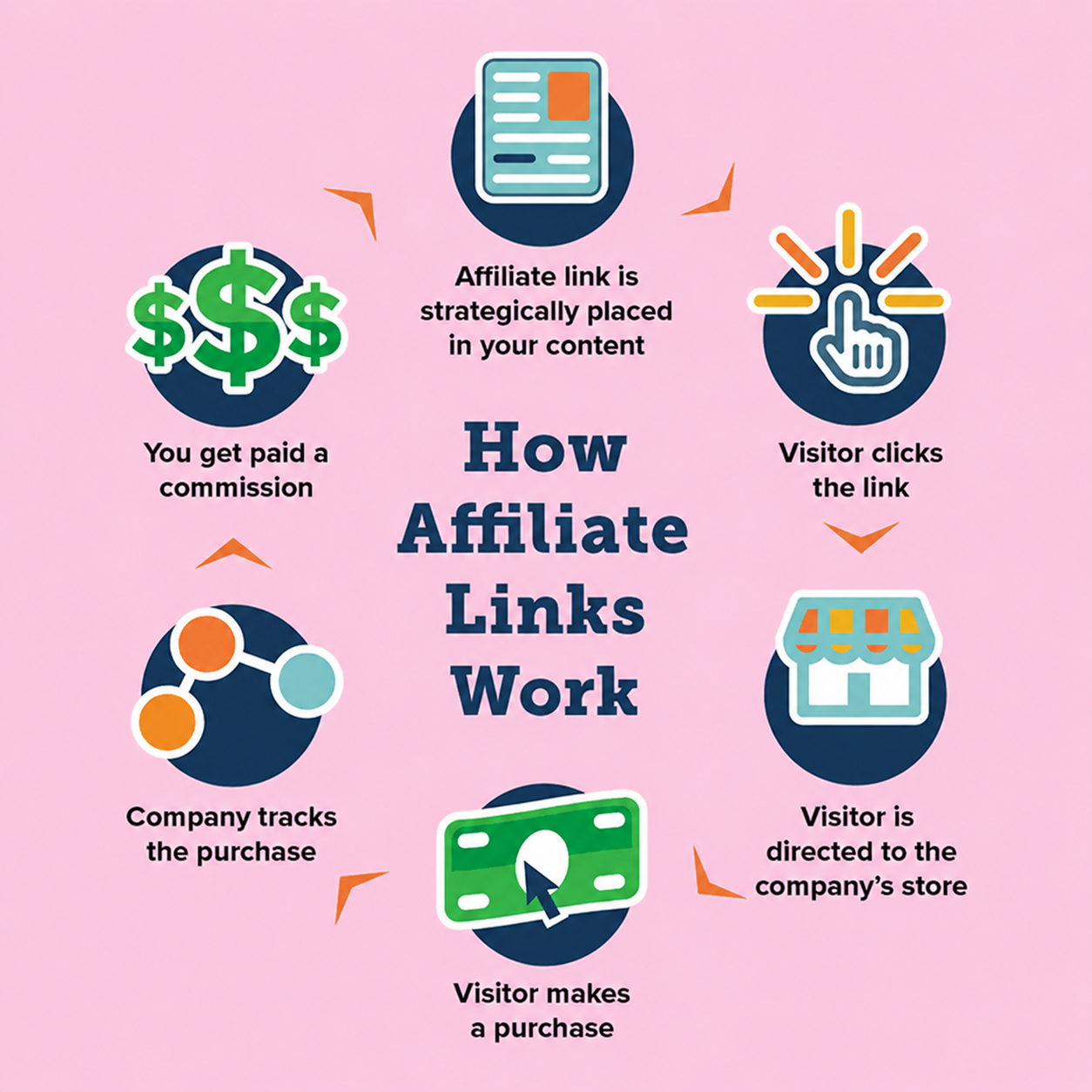
Affiliate links function on the basis of adding a unique identification number to a URL address in which the identity of the referrer is known. Once the URL is clicked, a cookie (or token from the server side) marks the clicker as a visitor referred by you. If the referred individual takes the target action, usually purchasing an item, in the time frame of the cookie window, the transaction is credited to your affiliate ID and you earn a commission from it.
What Is an Affiliate Link, Really?
An affiliate link is a specially coded URL assigned to a specific publisher — that’s you, the affiliate — by a brand or affiliate network. Every time someone clicks your link and completes a target action (usually a purchase), you earn a commission.
It looks like a regular web link on the surface. But buried in that URL is a unique tracking ID tied to your account. That ID is what tells the merchant, “This sale came from Victor’s website”, and that’s how you get paid.
Here’s a simplified example of what one might look like:
The ?ref=affiliate123 part is the tracking parameter. That tiny string of characters is what makes the whole system tick.
Read More: How to Start Affiliate Marketing While Growing Your Audience
How Affiliate Links Work: The Step-by-Step Breakdown
Understanding how affiliate links work means following the journey from click to commission. It’s actually a pretty elegant system once you see all the moving parts.
Step 1: You Join an Affiliate Program
First, you apply to promote a brand’s products. This can be either directly through their website or via an affiliate network like Amazon Associates, ShareASale, or Impact. Once approved, you get access to your unique affiliate links for their products.
Step 2: You Share the Link
You embed your link inside content — a website review, a YouTube video description, a newsletter, a social media post. Wherever your audience is, that’s where your link goes.
Step 3: Someone Clicks
A reader clicks your link. In that instant, something important happens: a tracking cookie is dropped on their browser (or, in more modern systems, server-side tracking kicks in). This cookie remembers that this particular visitor came from you.
Step 4: They Buy (or Sign Up, or Subscribe)
The visitor lands on the merchant’s site and — ideally — completes the desired action. That might be a purchase, a free trial signup, a form submission, or a subscription. Different programs track different actions.
Step 5: You Get Credited
The merchant’s system matches that conversion to your affiliate ID and records the commission in your account. Once it clears (usually after a refund window passes), the money gets paid out.
That whole sequence is how affiliate links work in practice. Simple in concept, powerful in execution.
|
Stage |
What Happens |
Who’s Involved |
|---|---|---|
|
Click Tracking |
Cookie or server token is set when reader clicks |
Affiliate, User, Network |
|
Landing |
User arrives on merchant’s product page |
User, Merchant |
|
Conversion |
User completes the target action (buy, signup, etc.) |
User, Merchant |
|
Attribution |
System matches conversion to affiliate ID |
Network / Merchant Platform |
|
Commission |
Earnings recorded and scheduled for payout |
Network, Affiliate |
Read More: Affiliate Marketing For Beginners Explained: How It Works Step by Step
Cookies, Tracking, and Why They Matter
When people ask how affiliate links work on a technical level, cookies are usually the answer. A cookie is a tiny file stored in your visitor’s browser that tells a website, “This person came from affiliate X.”
Cookie duration is one of the most important details to check before joining any program. It determines how long after a click you can still earn credit for a conversion.
|
Cookie Duration |
Example Programs |
What It Means for You |
|---|---|---|
|
24 hours |
Amazon Associates |
Only earn if they buy same day — tough |
|
7 days |
Some SaaS programs |
A little breathing room |
|
30 days |
ShareASale merchants |
Standard and workable |
|
60–90 days |
ClickBank, many retailers |
Comfortable window for conversions |
|
Lifetime |
ConvertKit, some B2B tools |
One referral can pay indefinitely |
But here’s where things get more interesting: the industry is shifting away from browser cookies. With browsers like Safari and Firefox blocking third-party cookies — and Chrome following — affiliate programs are increasingly using:
- First-party cookies: Set by the merchant’s own domain, these are harder to block and more reliable.
- Server-side tracking: Conversion data passes between servers instead of relying on the user’s browser — much more resilient.
- Fingerprinting: Uses device and browser characteristics to identify returning users without cookies.
- Postback URLs (S2S): The affiliate network pings the merchant’s server directly when a conversion fires — no browser involved at all.
If you’re choosing between affiliate programs, it’s worth asking which tracking methods they use. Server-side tracking is the gold standard right now.
Types of Affiliate Links You’ll Come Across
Not all affiliate links are built the same. Here’s a rundown of the main types and when you’d use each one:
- Standard tracking links: The classic — a URL with your affiliate ID embedded as a query parameter. Works fine for most purposes.
- Deep links: Instead of sending someone to a homepage, these drop them directly on a specific product or landing page. Higher conversions, fewer drop-offs.
- Cloaked / pretty links: Your long, messy affiliate URL disguised as something clean like yourwebsite.com/recommends/product. Better-looking, easier to remember, and some programs actually require them.
- Dynamic links: Generated automatically, sometimes with real-time parameters like geo-location, device type, or campaign tag. Common in large networks.
- Postback/S2S links: Server-to-server links that skip the browser entirely. Mostly used in app installs and high-volume affiliate setups.
Read More: Influencer Marketing You Need To Know
Commission Structures: How You Actually Get Paid
Understanding how affiliate links work financially is just as important as the technical side. Commission structures vary wildly between programs, and picking the right type can make a huge difference to your bottom line.
|
Commission Type |
How It Works |
Best For |
|---|---|---|
|
Pay Per Sale (PPS) |
% of sale or flat fee when purchase completes |
E-commerce, retail, Amazon |
|
Pay Per Lead (PPL) |
Fixed fee when user signs up or fills a form |
Finance, insurance, SaaS trials |
|
Pay Per Click (PPC) |
Tiny fee per click regardless of conversion |
High-traffic sites, display |
|
Recurring / Revenue Share |
Ongoing % of subscription payments |
SaaS, membership platforms |
|
Two-Tier |
Earn from affiliates you recruit below you |
Affiliate networks, MLM-adjacent |
Recurring commissions are where the real leverage is. Promote a $50/month SaaS tool at 30% commission, and a single referral generates $15 every month they stay subscribed. Ten referrals is $150/month on autopilot. That compounds fast.
Read More: What is Digital Marketing?
Disclosure Rules: What You’re Legally Required to Do
This part isn’t optional. In most countries, disclosing affiliate relationships is a legal requirement — not a courtesy. In the US, the FTC mandates that any material connection between you and a brand must be clearly disclosed. The UK’s ASA and ICO have similar rules. The EU’s GDPR adds cookie consent requirements on top of that.
What a proper disclosure looks like:
- Placed before the affiliate link, not buried at the bottom of a 2,000-word post
- Written in plain language your audience can actually understand — “This post contains affiliate links. If you buy through them, I earn a small commission at no extra cost to you.”
- Present on every page or post that contains affiliate links, not just a generic site-wide disclaimer
- Visible on mobile — not hidden by pop-ups or collapsed accordions
Here’s the thing though: disclosure actually helps conversion rates. Readers who know you earn a commission and trust your recommendation anyway are more likely to click than people who feel tricked later. Transparency is good ethics and good business.
Read more: How to Grow Your Audience With Affiliate Marketing
Best Practices That Actually Move the Needle
Knowing how affiliate links work mechanically is only half the picture. Making them work for you requires strategy. Here’s what separates affiliates who earn a few dollars a month from those who build real income streams:
- Match links to content intent. A link to running shoes in a “how to run your first 5K” guide converts. The same link in a recipe post doesn’t.
- Write reviews based on actual experience. Google’s helpful content systems and your readers can both tell when a review is genuine versus assembled from a spec sheet.
- Use your link naturally, not desperately. One or two well-placed links in a post beats ten scattered ones. Overlinking reads as spammy.
- Test placements and CTAs. “Check the current price →” consistently outperforms “click here” in most niches. A/B test everything.
- Keep links up to date. Broken affiliate links are lost money. Audit regularly — especially after affiliate programs change terms or products get discontinued.
- Build your email list. Email subscribers convert at 3–5× the rate of social followers. Getting your links in front of a warm list is one of the most underused leverage points in affiliate marketing.
Read More: How to Measure Digital Marketing Success: Essential Metrics and Analytics Guide
Common Mistakes That Kill Your Affiliate Earnings
Here’s the honest side of how affiliate links work in practice — most people make preventable mistakes that cost them commissions. Avoid these:
- Promoting products you haven’t used. Hollow reviews tank trust. Readers notice. Google notices. Your conversion rate suffers.
- Ignoring cookie duration. Signing up for a program with a 24-hour cookie and then creating long-form evergreen content is a mismatch. Know what you’re working with.
- Skipping mobile optimization. More than 60% of website traffic is mobile. If your affiliate links sit in content that’s hard to read on a phone, you’re leaving clicks on the table.
- Not tracking performance. If you don’t know which posts are generating clicks and conversions, you can’t double down on what works.
- Relying on cookie-only tracking. As discussed, this is increasingly unreliable. Check whether your top programs offer server-side or first-party options.
Frequently Asked Questions
Here are the best answers to the most valuable questions asked by new and pro affiliate professionals.
1. How do affiliate links work if someone doesn’t buy right away?
That’s where cookie duration comes in. If someone clicks your link but purchases two days later, you still get credit — as long as the cookie is still active on their browser. Maximizing your potential for earning passive income involves knowing about tracking windows.
2. Can multiple affiliates get credit for the same sale?
Usually not. Most programs use last-click attribution, meaning the final affiliate link clicked before purchase gets full credit. Some advanced programs split credit across the buyer’s journey.
3. Do affiliate links hurt SEO?
Not if handled correctly. Add a rel=”nofollow” or rel=”sponsored” attribute to your affiliate links so Google doesn’t count them as editorial endorsements — this protects your site’s search rankings. These types of relationships being disclosed effectively help in building user trust and ensuring compliance with various rules for digital marketing and advertising. This is an extremely significant consideration.
4. How do you get the link?
After joining a merchant’s affiliate program or an affiliate network (like Amazon Associates or ShareASale), you are given a unique, trackable URL or promo code. This link uses specific parameters to tell the merchant exactly which affiliate referred the buyer. To maximize your passive income, naturally incorporate these high-converting links into product reviews, blog posts, and tutorials. You can either use the unique tracking URLs directly from your affiliate dashboard or use the site stripe tools provided by the network.
Final Thoughts
Once you understand how affiliate links work — from the tracking mechanics to the commission structures to the legal requirements — the whole model starts to make a lot of sense. It’s performance-based, it’s transparent, and when done right, it’s genuinely useful for your audience.
You’re not just slapping links into content and hoping for the best. You’re connecting people who have a problem with a product that solves it — and earning a fair cut for making that connection. That’s a legitimate business model, and millions of creators and marketers are building real income from it.
Pick one program. Write one honest piece of content. Put your link in it. Track the results. Then do it again. That’s literally how it starts.
Related Contents:
- Influencer Marketing You Need To Know
- Affiliate Marketing For Beginners Explained: How It Works Step by Step
- The Ultimate Guide to Growing Your Online Business
- How to Grow Your Audience With Affiliate Marketing
- The 4 Best AI Apps For Marketers
- How to Measure Influencer Marketing ROI
- What is Digital Marketing?
- How to Start Affiliate Marketing While Growing Your Audience
- Micro-Influencers vs. Mega-Influencers: Which Delivers Better ROI?
- How to Measure Affiliate Marketing ROI