
Written by: Segun Akomolafe
In the current digital-age and rapid world, it is important to know how to develop a digital marketing plan and this has been the critical part of all businesses regardless of their sizes. The digital marketing strategy is your guide to online success whether you are starting a business or expanding a business that already exists. This step by step guidebook will lead you through all the most essential stages, including the identification of your target audience to the evaluation of the campaign performance, so that you can establish a strategy that will produce quantifiable outcomes and long-lasting development.
The online marketing environment keeps changing at a very fast rate, with new platforms, technologies and behaviors of consumers coming out every day. In the absence of a systematic orientation, companies will become resource wasteful as a result of poor strategies. Understanding how to develop a digital marketing plan that can respond to market dynamics and still keep the focus on the primary goals is a difference between successful brands and organizations unable to find their way in the digital environment.
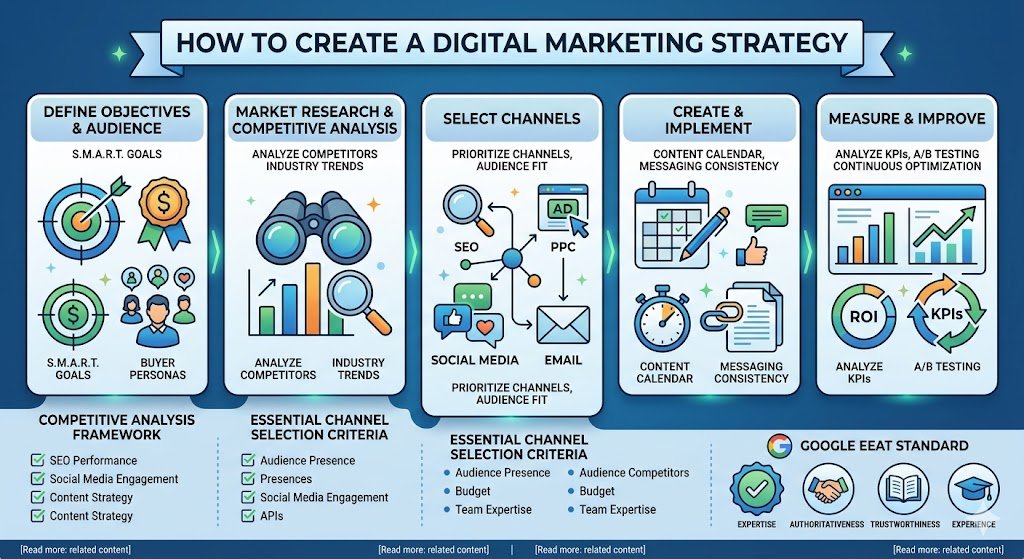
Knowing Your Business Objectives and Focus Market
A winning digital marketing strategy will be based on crystal-clear business objectives. You have to find out what you need to accomplish before going into tactics and channels. Are you interested in raising brand awareness, creating qualified leads, promoting e-commerce sales or creating customer loyalty? Your targets must be SMART goals i.e., Specific, Measurable, Achievable, Relevant, and Time-bound.
It is also essential to create elaborate buyer personas. By knowing the demographics, psychographics, pain points, and online behaviors of your ideal customers, you can create messages that appeal. Studies need to be done regarding where your target audience spends their time online, what they read and how they make buying decisions. This intelligence explicitly tells you which digital marketing channels are worth your investment and your value proposition communication strategy.
Read more: What is Digital Marketing?
Conducting Competitive Analysis and Market Research
Competitive intelligence provides invaluable insights when determining how to create a digital marketing strategy that stands out. Analyze your top competitors’ digital presence across all channels. What keywords are they ranking for? Which social media platforms generate their highest engagement? What type of content performs best for them? Tools like SEMrush, Ahrefs, and SimilarWeb reveal competitors’ traffic sources, paid advertising strategies, and content gaps you can exploit.
Market research extends beyond competitor analysis to understand broader industry trends, emerging technologies, and shifting consumer preferences. Stay informed about algorithm updates from major platforms like Google and Facebook, as these directly impact your strategy’s effectiveness. Industry reports, customer surveys, and social listening tools help you anticipate market shifts before your competitors react.
Competitive Analysis Framework
| Analysis Area | Key Metrics | Tools to Use |
|---|---|---|
| SEO Performance | Organic Keywords, Domain Authority | Ahrefs, SEMrush, Moz |
| Social Media | Engagement Rate, Follower Growth | Sprout Social, Hootsuite |
| Content Strategy | Publishing Frequency, Content Types | BuzzSumo, ContentStudio |
Selecting The Most Appropriate Digital Marketing Channels
Digital marketing channels are not equally valuable to every business. In learning how to prepare a digital marketing strategy, channel selection is where you have to match the preference of your audience with the capabilities of your business. Search engine optimization (SEO) generates long-term organic presence whereas pay-per-click (PPC) advertising provides instant traffic. Content marketing achieves thought leadership and email marketing develops relationships with existing customers with very high ROI.
Community building and development of brand personality are two areas where social media marketing is very successful. LinkedIn is usually the most effective in B2B businesses, whereas Instagram, Facebook, or Tik Tok can be utilized by the brands of B2C, depending on the target audience. Video marketing continues to acquire power on all platforms, where YouTube, Instagram Reels, and Tik Tok are providing a variety of opportunities to reach the audience with visual storytelling.
Read more: The Ultimate Guide to Instagram Marketing
Essential Channel Selection Criteria
When evaluating which channels to prioritize in your digital marketing strategy, consider these critical factors:
- Audience presence and engagement patterns on each platform
- Budget allocation and cost-effectiveness for your industry
- Team expertise and resource availability for content creation
- Time horizon for results (immediate vs. long-term growth)
- Competitive landscape and saturation levels in specific channels
Creating Compelling Content and Messaging
Content forms the backbone of any digital marketing strategy. Your content must solve problems, answer questions, and provide genuine value rather than simply promoting products. Develop a content calendar that balances educational resources, entertaining material, and promotional messaging. Different content formats serve different purposes—blog posts for SEO and thought leadership, videos for engagement and explanation, infographics for data visualization, and case studies for social proof.
Messaging consistency across all touchpoints reinforces brand recognition and trust. Establish clear brand guidelines covering tone of voice, visual identity, and key value propositions. Your messaging should address specific pain points for each buyer persona at different stages of their customer journey. Use storytelling techniques to create emotional connections that transcend transactional relationships.
Stop monitoring algorithms and start establishing trust. prioritize “Answer Engine Optimization” (GEO), use AI agents for curation rather than creation, and manually create original, unique contents.
Content Types and Their Primary Uses
| Content Format | Primary Benefit | Best Use Case |
|---|---|---|
| Blog Posts | SEO & Organic Traffic | Answering Customer Questions |
| Video Content | High Engagement Rates | Product Demonstrations |
| Infographics | Social Media Sharing | Complex Data Visualization |
| Case Studies | Building Credibility | B2B Lead Generation |
Read more: How to Build an Influencer Network That Drives Consistent ROI
Establishing Budget and Resource Allocation
The budget planning is one of the most difficult things to consider when trying to come up with a digital marketing strategy. To start with, just calculate the overall marketing budget as a percentage of revenue industry averages are 5-15% at each growth stage and level of competitiveness. Allocation is done depending on channel efficacy, testing funds, and strategic priorities. Allocate 10-20% of reserves to test new platforms and strategies.
Resource allocation is not limited to monetary aspects but also to team talent, time and technology. Determine whether you will do tasks internally, contract freelancers or go with agencies. Marketing automation systems, analytics systems, and content management systems need monetary investment and employee training. Determine the actual cost of each line of distribution, software subscriptions, content creation and staff time.
Read more: Influencer Marketing You Need to Know
Strategy Implementation and Strategizing
Implementation makes your digital marketing strategy come to life. Establish step-by-step action plans, including timeframes, assigned individuals, and objectives of success in every initiative. Organize team work, monitor progress, and hold team members accountable using project management tools. The pilot campaigns can be used to test the assumptions in advance and then roll out the full implementation to give you time to revise your strategies based on the actual performance data.
When it comes to strategy, it is consistency that counts rather than perfection. Consist in content publication, be active on social media, develop leads via systematized email campaigns. Establish standard operating procedures to be used in repetitive jobs so that quality will not be compromised by increase in volume. Record the things that work and those that do not to keep on improving on how to do it.
Read more: Ultimate Guide to Growing Your Online Business
Performance Measurement and Continuous Improvement
Professional digital marketing and guesswork can be differentiated by measurement ability. Determine important performance indicators (KPIs) that will be consistent with your business objectives. Quantifiable evidence of strategy effectiveness is offered in terms of website traffic, conversion rates, cost of customer acquisition and return on investment. Initiate an appropriate tracking in all channels through Google analytics, CRM and channel analytics platforms.
The ongoing optimization process means that it should be analyzed frequently and be ready to pivot according to the information obtained. Carry out monthly performance reviews of what is working and what is not working. Test all A/B test email subject lines, landing page designs, ad copy, and placement of call-to-action. If you choose to grow your brand with affiliate marketing, it’s better you learn how to measure affiliate marketing ROI for stress free growth. The most effective digital marketers consider their tactics living documents that are improved with the help of the market feedback and performance statistics.
Read more: 10 Types of Digital Marketing
Essential Digital Marketing KPIs to Track
| Metric Category | Specific KPIs to Monitor |
|---|---|
| Traffic Metrics | Unique Visitors, Page Views, Session Duration |
| Engagement Metrics | Social Shares, Comments, Bounce Rate |
| Conversion Metrics | Lead Generation, Sales, Conversion Rate |
| Financial Metrics | ROI, Customer Acquisition Cost, Lifetime Value |
Your digital marketing strategy is strengthened and long-term visibility and customer trust are increased by incorporating audience engagement, consistent content, and clear brand messaging across various platforms.
Read more: How to Measure Influencer Marketing ROI
Frequently Asked Questions
The answers to the most frequent questions regarding developing an effective digital marketing strategy are provided below.
What is the duration of the digital marketing strategy to realize results?
Results vary by channel. Paid advertising is able to get instant traffic and SEO normally takes 3-6 months to gain substantial organic growth. Social media and content marketing have a slow recovery, which gains momentum over time, with constant effort and optimization.
How much money should I spend on digital marketing?
The marketing budgets are recommended to be 5-15% of revenue by industry standards. Newer firms tend to invest more percentages (15-20) in the creation of awareness whereas old firms have 5-10. Divide according to your growth targets, competition and customer acquisition expenses in the market.
Should I develop a digital marketing strategy?
The decision is based on financially, skills requirement and the type of control. Agencies have direct immediate experience in specialties, but are expensive. Internal teams offer greater understanding of the brand and have control but they need time to develop. A hybrid strategy is employed by many businesses whereby they are running their strategy in-house and outsourcing special work.
Conclusion
The process of learning to develop a digital marketing strategy is a long process and not a single task. The digital environment keeps on changing with new platforms, technologies, and behaviors by consumers coming out every now and then. To be successful, you need to know what is happening in the industry, you have to be flexible in your method and also you must always be ready to test new strategies even though you should also be maximizing the strategies that have worked.
It is important to remember that the best digital marketing plans are those that combine both the rational use of data and the creative innovativeness. Begin with a strong base that is anchored on precise goals, profound audience insights and competitive intelligence. Implement continuously, test continuously, and evaluate continuously.
Using the plan that is presented in this guide, you will manage to create an effective digital marketing strategy that will promote the growth of your business on a long-term basis and be able to adjust to the changes that the market will present to you in the future.
Related Contents:
- What is Digital Marketing?
- How to Create an Influencer Marketing Strategy for Your Business
- 10 Types of Digital Marketing
- How to Measure Influencer Marketing ROI
- Micro-Influencers vs. Mega-Influencers: Which Delivers Better ROI?
- Influencer Marketing You Need to Know
- The Ultimate Guide to Instagram Marketing
- The Ultimate Guide to Growing Your Online Business
- How to Find the Right Influencers for Your Brand
- How to Scale Your Influencer Marketing Business