
Written by: Segun Akomolafe
The online environment has changed how companies relate to their customers. Every business that wants to be successful in the current competitive online world has to be aware of various types of digital marketing.
From search engines to social media networks then email campaigns to relationships with influencers, every marketing channel has its own opportunities to connect with your target customers. This is the ultimate guide to the most successful digital marketing tactics successful brands are using to push their growth, relationship with the customers and get quantifiable outcomes the more digital-first world becomes.
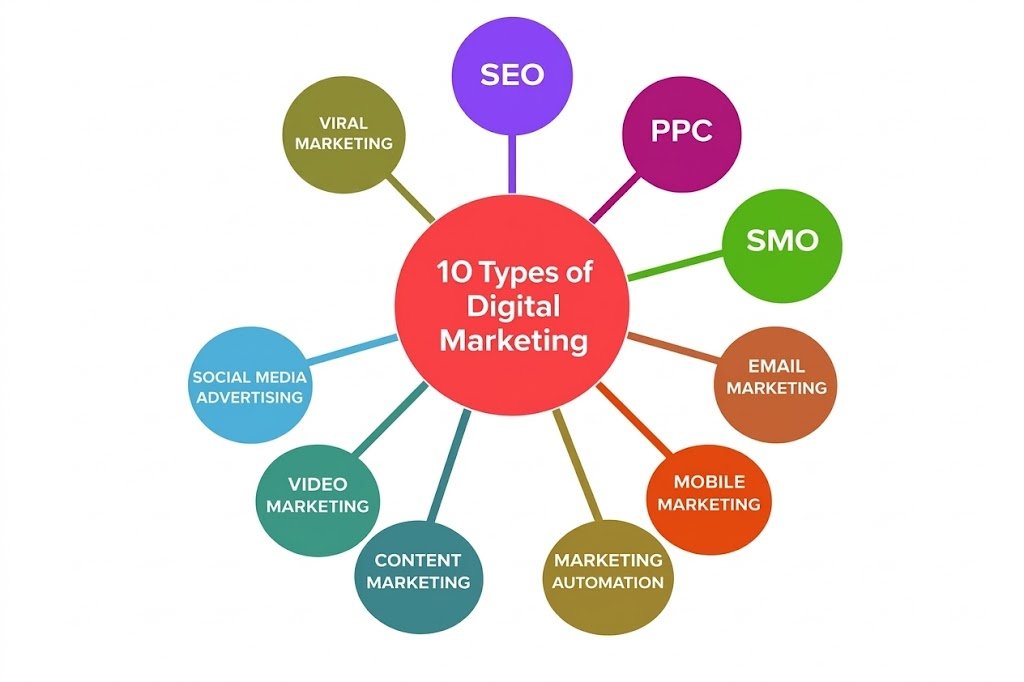
Learning Digital Marketing Channels
Digital marketing involves a wide variety of channels and strategies that can together be used to generate a united online presence. It is possible that each channel has its own purpose and the audience that belongs to each stage of the buyer journey while driving targeted organic traffic and measurable ROI through high-converting keyword optimization strategies and comprehensive backlink profiles that improve search engine rankings.
The easiest secret to success is knowing how these channels supplement one another and the correct combination to achieve what your business has in mind. A startup with little resources or an established enterprise, with the knowledge of the strengths and uses of specific types of marketing, you can spend your budget properly and get the best out of your investment.
Read more: How to Build an Influencer Network That Drives Consistent ROI
Search Engine Optimization (SEO)
Search Engine Optimization is one of the most valuable types of digital marketing for building sustainable organic traffic. SEO involves simply optimizing your website and content to rank higher in search engine results pages for relevant keywords. A strong strategy ensures higher visibility and continuous customer growth opportunities by targeting user intent and improving technical site performance. Unlike paid advertising, SEO provides long-term value as your rankings get better over time.
The practice encompasses technical optimization (site speed, mobile responsiveness, structured data), on-page factors (content quality, keyword usage, internal linking) and off-page signals (backlinks, domain authority, social signals). Great SEO requires patience and consistent effort, but the rewards include reduced customer acquisition costs, increased credibility and sustainable traffic growth that compounds over months and years.
Pay-Per-Click (PPC) Advertising
Pay-Per-Click advertising basically delivers quick visibility and traffic through paid placements on search engines and other platforms. By optimizing your landing pages for high intent keywords, you’ll get the most out of your digital marketing campaign spend. Google Ads, Microsoft Advertising, banner ads, influencer marketing and social media ad platforms allow you to bid on keywords and display your ads to users actively searching for your products or services.
PPC offers unmatched targeting precision. This enables you to reach specific demographics, locations, interests, and behaviors. The pay-per-click model ensures you only pay when users click your ads, making it cost-effective when managed properly. Advanced features like remarketing, audience segmentation, and conversion tracking provide granular control and measurement capabilities that traditional advertising cannot match.
Read more: What is Digital Marketing?
Content Marketing
Content marketing focuses on building and distributing valuable, relevant content to attract and retain a clearly defined audience. This strategic approach builds trust and authority while guiding prospects through the buyer journey. Effective content marketing encompasses blog posts, ebooks, whitepapers, case studies, courses, webinars, podcasts and more. By strategically optimizing these materials with targeted keywords, brands can basically improve organic search visibility and drive highly qualified website traffic.
The key differentiator is providing genuine value rather than direct promotion. By addressing customer pain points, answering questions, and educating your audience, you position your brand as an industry thought leader. Content marketing supports other digital channels by providing material for social media, improving SEO through fresh content, and nurturing email subscribers with valuable resources.
|
Content Format |
Primary Benefit |
Best Use Case |
|---|---|---|
|
Blog Posts |
SEO & Regular Traffic |
Answering Customer Questions |
|
Video Content |
High Engagement |
Product Demonstrations |
|
Infographics |
Social Sharing |
Complex Data Visualization |
Social Media Marketing
Social media marketing leverages platforms like Facebook, Instagram, LinkedIn, Twitter and TikTok to build brand awareness, engage communities, and drive conversions. Through the application of analytics and proper scheduling on different digital marketing platforms, social media is able to create an interactive environment between you and your consumers. Utilizing the correct content strategies, including relevant keywords and a regular posting schedule, is key to maximizing organic reach and improving search engine rankings.
Each platform serves different demographics and content types: LinkedIn for B2B professional networking, Instagram for visual storytelling, Twitter for real-time updates and customer service, and TikTok for reaching younger audiences through creative video content. Successful social media strategies combine organic content with paid advertising, influencer partnerships, and community management to build loyal followings that amplify your brand message.
Read more: The Ultimate Guide to Instagram Marketing
Email Marketing
Email marketing delivers the highest ROI among digital marketing channels, with an average return of $42 for every amount of dollar spent. This direct communication channel allows you to nurture leads, retain customers, and drive repeat purchases through personalized messaging. Modern email marketing goes beyond simple newsletters to include sophisticated automation sequences, behavioral triggers, dynamic content personalization, and advanced segmentation.
Welcome series onboard new subscribers, abandoned cart emails recover lost sales, and re-engagement campaigns win back inactive customers. The key to email success lies in providing value, maintaining consistent communication without overwhelming subscribers, and continuously testing subject lines, content, and send times to optimize performance.
|
Campaign Type |
Primary Purpose |
|---|---|
|
Welcome Series |
Onboard new subscribers and set expectations |
|
Promotional Emails |
Drive sales through special offers and discounts |
|
Newsletter |
Provide value and maintain regular engagement |
|
Abandoned Cart |
Recover lost sales and reduce cart abandonment |
Affiliate Marketing
Affiliate marketing works on performance-based initiative where organisations compensate partners due to their marketing activities resulting in traffic or sales. The fact that this is one of the types of digital marketing that minimize the risk of encountering costs should be taken into consideration. Affiliates drive your goods using their websites, blogs, social media platforms or email lists, and get commissions on sales made.
It is a win-win situation: businesses do not have to spend money on advertising and promoting their products to any audience, and affiliates can earn income because of recommending products that they are sure that people will use. Effective affiliate programs need to have effectively defined commission models, good promotional resources, effective tracking applications and good partner relations that will work well with your brand philosophies.
Influencer Marketing
Influencer marketing involves using the audience and the authority of social media figures to distribute goods and services to their respective followers. In contrast to the conventional celebrity endorsements, the influencer partnerships of today boil down to mega-influencers with millions of followers or micro-influencers with well-developed niche communities.
Studies indicate that micro-influencers are likely to provide superior engagement and ROI because micro-influencers are authentic to their followings. Effective influencer campaigns need to be approached with the selection of partners according to their alignment with the audience, defined campaign goals, liberty to express a creative idea, and openness to share sponsored relationships. It has a great track record in brand awareness, the introduction of new products as well as the younger demographics who do not believe in conventional advertisement but rather peer recommendations.
|
Influencer Type |
Follower Range |
Key Advantage |
|---|---|---|
|
Nano-Influencers |
1,000 – 10,000 |
Highest Engagement Rates |
|
Micro-Influencers |
10,000 – 100,000 |
Cost-Effective & Niche Targeting |
|
Macro-Influencers |
100,000 – 1 Million |
Broad Reach & Credibility |
|
Mega-Influencers |
1 Million+ |
Maximum Reach & Visibility |
Read more: How to Measure Influencer Marketing ROI
Video Marketing
Video marketing has now proved to be one of the most effective forms of digital marketing and it has been found that the video contents create 1200% share as compared to a combination of text and pictures. YouTube, Tik Tok, Instagram Reels, Whatsapp business, and LinkedIn Video are the platforms that offer various opportunities to appeal to the audience with visual storytelling.
Video is the best in explaining complicated products, creating emotional engagements, proving value propositions, and enhancing information recall. The formats include brief social media videos and long-term educational videos, product videos, customer reviews and livestreams. The democratization of video marketing has been brought about by the increase in mobile video consumption and the increased access to production via smartphones, making it possible to use this appealing medium of marketing by businesses of all sizes.
Mobile Marketing
Mobile marketing includes the mobile-specific strategies that target smartphones and tablets because it is understood that more than 60 percent of internet traffic is mobile-based. Optimizing these campaigns drives higher local conversion rates and engages users instantly. This broad classification of digital marketing involves SMS marketing, mobile app marketing, location-based advertising, mobile-optimized email marketing, and responsive web design.
The features of the mobile devices allow contextual targeting based on the place, time of the day and the activities of the device. Mobile wallets ensure smooth transactions, whereas push notifications keep the brands in the mind but are not intrusive. Effective mobile marketing involves the consideration of mobile user experience: the lack of attention, the verticalization of the screens, the use of touch, and on-the-fly consumption behavior that is radically different as compared to desktop browsing behavior.
Essential Mobile Marketing Tactics:
- Optimize websites for mobile-first indexing and fast loading speeds
- Implement SMS marketing campaigns with clear opt-in and value propositions
- Develop mobile apps that provide genuine utility beyond your website
- Use location-based targeting to deliver contextually relevant offers
- Create mobile-friendly landing pages with simplified forms and clear CTAs
- Test campaigns across multiple devices and operating systems
Marketing Automation
Marketing automation involves software systems that facilitate, automate and quantify marketing activities and processes. The technology allows companies to nurture leads on a large scale, providing individualized experiences based on actions, preferences, and stage of the lifecycle. Automation platforms are connected with the CRM and have the ability to trace their customer paths through the first touch to conversion and elsewhere.
Most of them are used in email drip campaigns, lead scoring, behavior triggers, personalization of dynamic content and coordination of multi-channel campaigns. Automation of repetitive activities will enable marketers to concentrate on strategy and creativity and to provide the prospects with consistent and timely communication that helps them to find their way through the sales funnel in the most efficient manner.
Read more: The Ultimate Guide to Growing Your Online Business
How to Select the Right Types of Business
The choice of the right types in digital marketing to your business varies depending on a range of factors: demographics of your target audience and online activities, budget and resources availability, business objectives and time projections, the complexity of products or services, and competitor backgrounds. B2B companies tend to value LinkedIn marketing and content marketing, as well as email nurturing whereas B2C businesses might pay more attention to social media, influencer partnerships, and paid searches.
You begin by determining where your perfect customer is spending time online and then do experiments for each channel one by one and evaluate your performance based on measurable KPIs. Very effective strategies are a combination of various complementary channels that support each other and influence the seamless overall customer experience on all touchpoints.
Frequently Asked Questions
The following are the most commonly asked questions on the nature of digital marketing and the most appropriate response to them.
Which type of digital marketing is the most economical?
The long-term ROI of content marketing and SEO is often the most appropriate because organic placements guarantee the sustainable flow of traffic without constant advertising expenses. Executing a well-planned digital strategy ensures maximum savings and continuous lead generation. This organic visibility builds brand authority and compound growth. SEO targets keywords and user intent to convert high-intent searchers into loyal customers, the organic way. Email marketing is also very cost effective with average returns of 42 dollars outlayed in the email marketing.
What is the number of digital marketing types to embrace at a given time?
Begin with 2-3 channels that will match your audience and perfect them first, after which you can expand using proven strategies like search engine optimization and social media marketing. When quality is implemented on smaller channels, it is better than mediocre performance across numerous channels. Improve user experience and continuously track analytics to maximize online visibility through targeted keyword research. Grow as resources and expertise get bigger to optimize your conversion rates, deeply engage your target audience and secure a higher return on investment for your brand.
What type of digital marketing provides the quickest outcomes?
Immediate traffic and conversion are provided by PPC advertising and paid social media. Leveraging high-intent keyword targeting and precise audience segmentation ensures immediate visibility. Nonetheless, they all need continuous investment. To achieve sustainable growth, use the quick-win paid strategies with slower-rewarding organic strategies, such as SEO and content marketing. Integrating these complementary channels lowers overall customer acquisition costs, boosts long-term domain authority and compounds your return on marketing investment over time.
Conclusion
The key to successful business in the online world is to understand and apply the appropriate combination of the types of digital marketing. The channels have their own advantages; SEO provides an organic presence, PPC has quick returns, content marketing allows to cultivate thought leadership, social media creates a sense of community, and email enhances relationships with customers. The digital environment is ever-evolving due to new technologies, the shift in customer habits, and new functionalities of the platform. Effective marketers are also flexible and they will constantly experiment with new methods as they streamline the best practices.
As of 2026, privacy-first, first-party data strategies, collecting direct audience input through communities and surveys, will be critical, replacing diminishing cookies with trust-driven, compliant and highly tailored consumer experiences.
With the right choice of channels that can support your business objectives, target customers’ tastes, and resources at your disposal, you develop a holistic digital marketing ecosystem that results in quantifiable growth. Find the basics to quantify what is required, be a student of data, and learn what works. The strategic planning, repeated implementation, and data-driven optimization will make your business successful in digital marketing in the long term.
Related Contents:
- What is Digital Marketing?
- How to Create an Influencer Marketing Strategy for Your Business
- What to Include in an Influencer Contract (+ Free Template)
- How to Measure Influencer Marketing ROI
- Micro-Influencers vs. Mega-Influencers: Which Delivers Better ROI?
- Influencer Marketing You Need to Know
- The Ultimate Guide to Instagram Marketing
- The Ultimate Guide to Growing Your Online Business
- How to Find the Right Influencers for Your Brand
- How to Scale Your Influencer Marketing Business