
Written by: Segun Akomolafe
The modern world has turned into a place of hyper-connections where business companies will lower the rate at which they use traditional methods of advertising. The question “what is digital marketing? is becoming significant as more companies are going online. In simple terms, digital marketing refers to all marketing activities involving the use of electronic gadgets or the internet to reach out to the existing and prospective clients. Digital marketing has transformed the manner in which brands interact with their audiences, starting with search engines and social media, email campaigns and content creation.
Knowledge of what digital marketing is extends beyond the definition. It is also about the strategic direction taken by businesses to reach the consumers in the most time they spend mostly online. Be it as a small business owner, marketing professional or an entrepreneur, learning how to master digital marketing channels can change enormously your business growth and customer acquisition techniques.
Digital marketing promotes products online via SEO, social media, email and PPC ads. This guide basically explains what digital marketing is and how to use it effectively.
Quick Answer
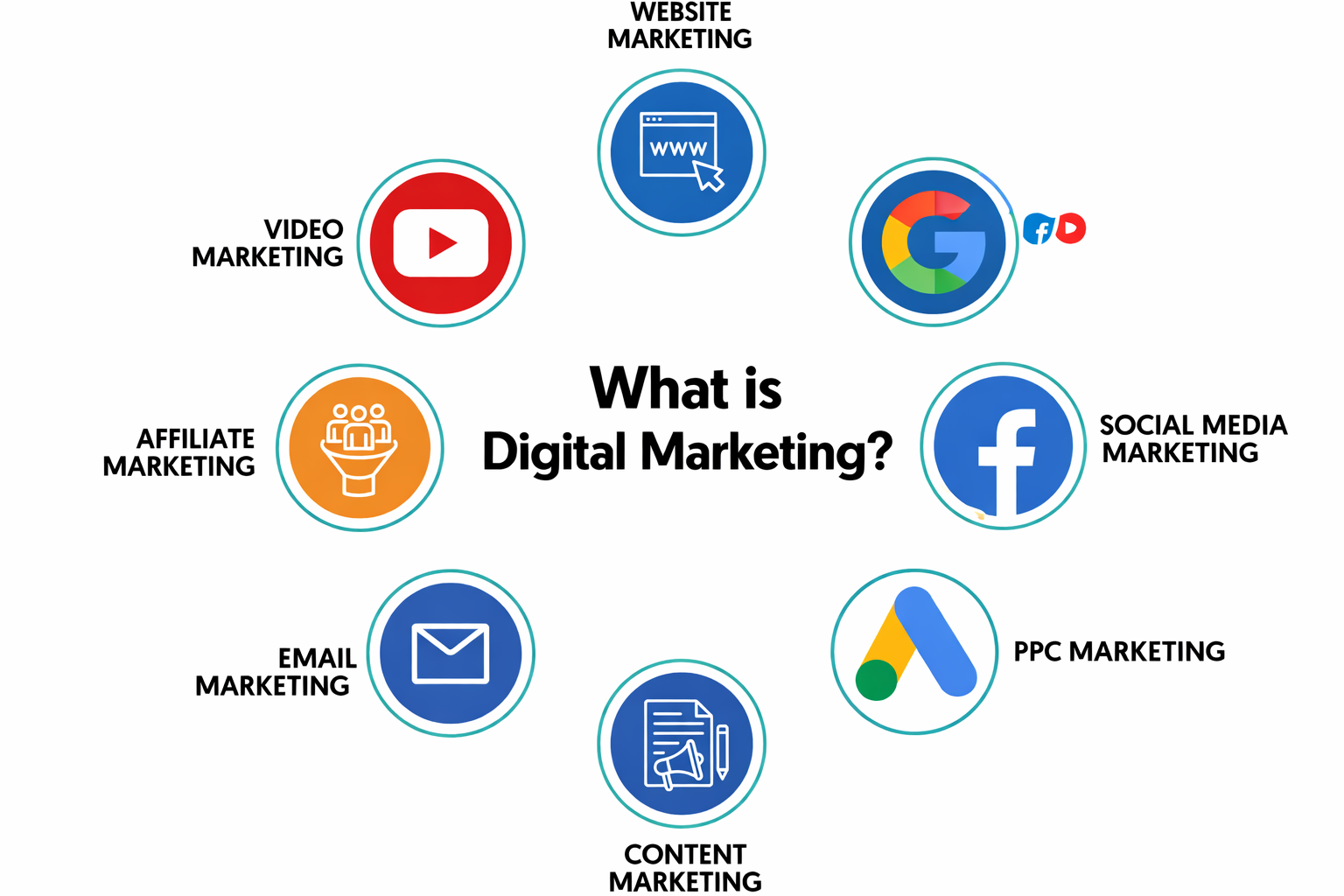
Digital marketing is the marketing of products or services using digital channels to reach consumers. The main tactics are SEO, content marketing, social media and email campaigns. Its main goal is to reach, engage and convert target audiences online with data-driven metrics and targeted advertising for a better ROI.
Core Components of Digital Marketing
In identifying what digital marketing is about, you will find it to comprise a number of inter-related channels that combine to develop a complete online presence. All the elements have a distinct role to play in capturing, hooking, and turning your target audience. Search engine optimization (SEO) enhances the visibility of your website in the organic search results whereas pay-per- click advertising provides instant visibility by paid placements.
Digital marketing is no longer just a side function; it’s the most important part of growing a business today. Using electronic devices and the internet to promote goods, services, or brands is called digital marketing. It uses data analytics to connect with customers at every stage of their buying process. Trust and authority are achieved through content marketing through delivering useful information to your audience.
Social media marketing uses social media such as Facebook, Instagram, LinkedIn, and Twitter to create communities and interactions. Email marketing is the most direct form of communication between the subscribers and those leads are cultivated with individual messages. A combination of these factors provides a compelling ecosystem that contributes to quantifiable business outcomes.
Read more: How to Build an Influencer Network That Drives Consistent ROI
Why Digital Marketing Matters
Digital space has changed significantly such that digital marketing has become a necessity and not a luxury. There are more than 5.4 billion internet users in the world and your customers are surfing- researching about products, comparing prices, reading reviews and making buying decisions.
The effectiveness of digital strategies cannot be compared with the traditional marketing channels in terms of their ability to reach more people, precision, and cost-efficiency. Online marketing offers never before seen benefits. Real time analytics are used to monitor campaign performance in real-time and change strategies according to real data and not guesses.
Consumers who care about their privacy are calling for more open data practices. Using first-party data collection to establish solid, direct customer relationships guarantees sustainable marketing while honoring user preferences and legal requirements.
Digital marketing has progressed beyond broadcasting messages to creating intimate, conversational encounters; it is no longer merely advertisements, but rather the primary, human-centered infrastructure for establishing trust.
Accurate targeting will make sure your message is delivered to the correct audience and at the right time and saves unnecessary costs on the uninterested prospects. Customers can be connected to on a personal level at a large scale, which is what forms the difference in achieving deeper customer interactions and increased conversion rates, unlike the mass marketing that could not accomplish this.
Digital Marketing Channels Comparison
| Channel | Primary Benefit | Best For |
|---|---|---|
| SEO | Long-term organic traffic | Building sustainable visibility |
| Social Media | Brand awareness & engagement | Community building |
| Email Marketing | Direct customer communication | Lead nurturing & retention |
| PPC Advertising | Immediate results & targeting | Quick traffic & conversions |
Read more: The Ultimate Guide to Instagram Marketing
Essential Digital Marketing Strategies
Digital marketing success is difficult without planning and implementation in different channels. It is underpinned by content marketing where you will develop useful resources that will attract and inform your audience. Doing this by publishing blog posts, videos, infographics, and podcasts on the subject of how it helps customers resolve their pain points, creates authority and develops trust before you ask to purchase.
The optimization of search engines will see your content reach individuals at the point of search. You will be able to optimize rankings and encourage quality traffic with the help of keyword research, on-page optimization, and quality link building.
Social media makes your message go viral and customers become the brand ambassadors who pass your content to their audiences. Automation of emails cultivates leads in a systematic manner and provides a personalized message that directs the prospects along the buyer path.
Through strategic, data-driven campaign execution, digital marketing connects brands with consumers via online channels like SEO, social media, content marketing and email. This results in quantifiable business growth.
AI has also basically improved from automated tasks to predictive analytics, content elevation and hyper-personalization, making it the foundation of marketing rather than just a research tool.
Read more: 10 Types of Digital Marketing
Key Elements for Success
Digital marketing delivers tailored content to specific demographics, behaviors and interests, increasing conversion rates. To have effective digital marketing, it is important to concentrate on a number of key factors that lead to the outcome:
- Defining the target audience: You know who you are targeting and this way all your marketing dollars are utilized effectively. Develop detailed buyer profiles consisting of demographics, behavior, pain points, and buying behavior.
- Data-driven decision making: Use analytics platforms to monitor user behavior, campaign performance and conversion. Apply these lessons to improve tactics and get rid of the strategies that are not working.
- Develop a brand message: Have a consistent voice, appearance and value proposition across all digital-based channels. Stability gives recognition and earns trust, as such, your marketing is more unforgettable.
- Mobile-first strategy: Responsive design and mobile-oriented content are the two essential requirements on the way to contemporary consumers as more than 60% of internet traffic is accomplished by mobile phones.
- Constant testing and improvement: Digital marketing is all about testing. Test headlines, images, call-to-actions and landing pages to see which ones will appeal the most to your audience.
Essential Digital Marketing Metrics to Track
| Metric | Why It Matters |
|---|---|
| Conversion Rate | Measures how effectively you turn visitors into customers |
| Customer Acquisition Cost (CAC) | Shows how much you spend to acquire each new customer |
| Return on Investment (ROI) | Determines profitability of marketing campaigns |
| Engagement Rate | Indicates content quality and audience interest |
| Customer Lifetime Value (CLV) | Predicts total revenue from customer relationship |
Read more: How to Measure Influencer Marketing ROI
Building Your Digital Marketing Foundation
Starting with digital marketing requires building a solid foundation before scaling campaigns. Begin by establishing clear, measurable objectives aligned with business goals. Whether you’re focused on increasing brand awareness, generating leads, or driving sales, specific targets guide strategy development and resource allocation.
Your website serves as the hub of all digital marketing activities. Ensure it loads quickly, displays properly on all devices, and provides clear paths to conversion. Implement analytics tracking from day one to gather data that informs future decisions. Create valuable content that addresses customer questions and positions your brand as a trusted resource in your industry.
Digital Marketing Implementation Timeline
| Phase | Key Activities |
|---|---|
| Month 1-2 | Website audit, audience research, competitor analysis, goal setting |
| Month 3-4 | Content creation, SEO optimization, social media setup, email list building |
| Month 5-6 | Campaign launch, paid advertising testing, performance tracking, optimization |
| Ongoing | Continuous testing, content publishing, audience engagement, strategy refinement |
Read more: The Ultimate Guide to Growing Your Online Business
Frequently Asked Questions
These are the 3 most commonly asked questions and answers to what is digital marketing.
What is the cost of digital marketing by small business enterprises?
The prices of digital marketing are diverse depending on the strategy, industry and objectives. Small businesses usually incur expenditures of $1,000 -10,000 a month on integrated programs that involve content making, advertisements, and tools. Begin small, calculate the ROI wisely and expand on the successful channels.
What is the time frame to realise the outcomes of digital marketing?
The schedule also depends on the channel. Paid advertising comes with instant traffic, whereas the time frame of SEO is 3-6 months before serious outcomes are experienced. The content marketing effect is long term and the returns compound over time, as long as the content is published and over time of 6-12 months of strategic implementation. In a nutshell, it is highly recommended to combine short-term paid strategies with long-term organic efforts to get the best results and make sure that growth is sustainable.
Would I be able to do digital marketing or would I employ professionals?
The two strategies operate based on expertise and resources. Small companies will tend to begin managing themselves to keep down expenses, and outsource professional services to complicated jobs. The bigger organizations usually have specific teams or agencies that have specialized information and a well-developed process. Ultimately, the choice depends on balancing your available time and budget against the need for rapid, specialized and scalable growth results.
Conclusion
A good knowledge of digital marketing is the basics to your online business success. It is an active and constantly changing area that compensates strategic thinking, life-long learning, and evidence based decision making. Whether it is search engine optimization to social media connection, email campaign to content creation, all the aspects will come together to create meaningful reports to your target audience.
The companies that are performing in the current digital economy are not the ones that have the largest budgets, but the ones that know their clients well and provide real value to them on an ongoing basis and easily adjust to the shifts in the market. Digital marketing is a relatively new field that provides easy and quantifiable means of expanding your business and competing efficiently in your field, whether you are just beginning or seeking to optimize the current strategies.
Begin by paying attention to one or two channels that your audience is the most active. Conquer those platforms before going to other platforms. Keep record of your achievements, make mistakes, and keep in mind that digital marketing is a long process, not a one-day international. Whatever you know and systems you develop today will compound in the future, resulting in sustainable competitive advantages that lead to long term business growth.
Related Contents:
- How to Build an Influencer Network That Drives Consistent ROI
- How to Create an Influencer Marketing Strategy for Your Business
- What to Include in an Influencer Contract (+ Free Template)
- How to Measure Influencer Marketing ROI
- Micro-Influencers vs. Mega-Influencers: Which Delivers Better ROI?
- Influencer Marketing You Need to Know
- The Ultimate Guide to Instagram Marketing
- The Ultimate Guide to Growing Your Online Business
- How to Find the Right Influencers for Your Brand
- How to Scale Your Influencer Marketing Business