
Written by: Segun Akomolafe
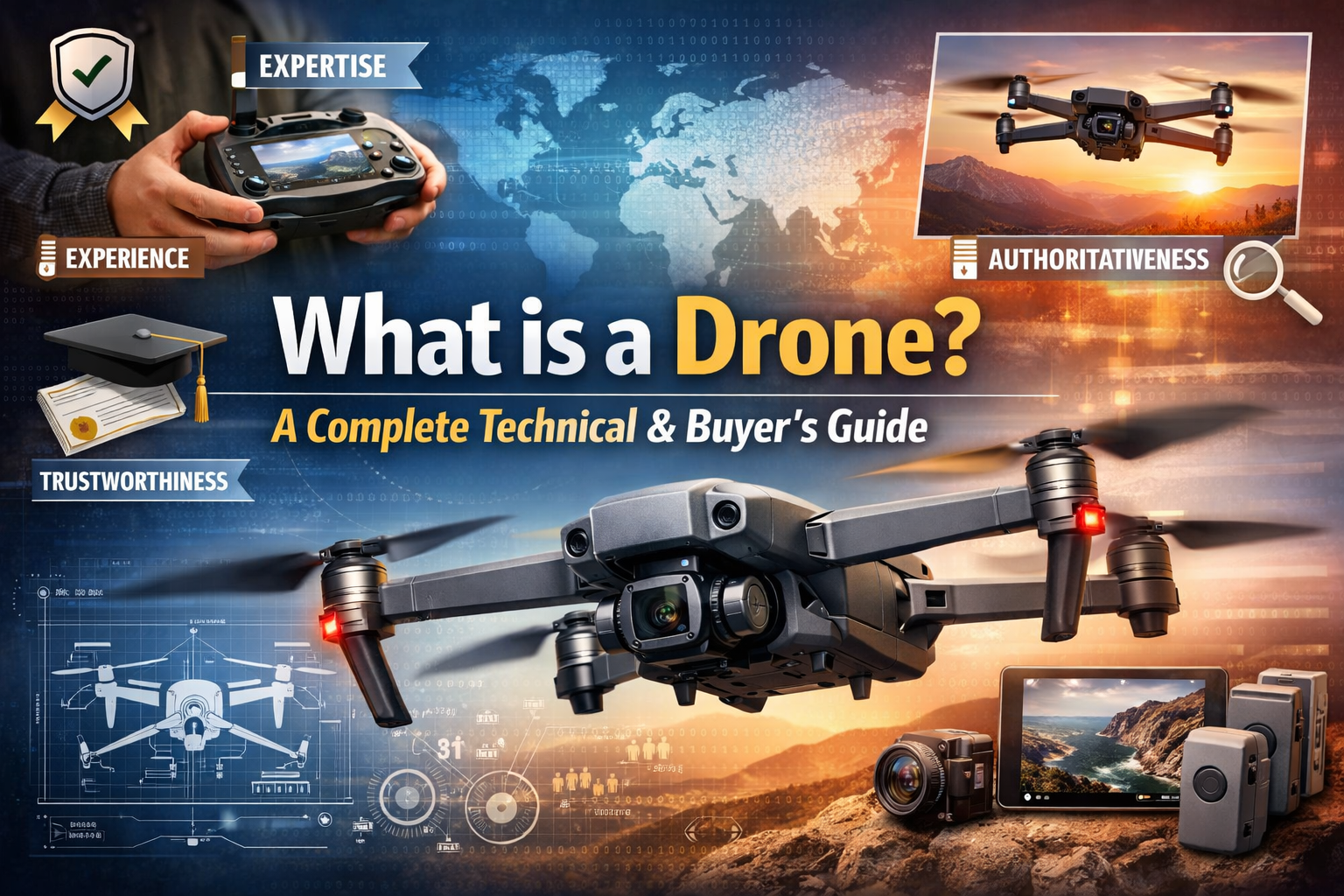
When you ever look up and see a buzzing thing hovering in the air steadily, recording the images of a construction site, or a sports event, you have already answered the research question that millions of people enter into Google every day: what is a drone? A drone in the simplest meaning is a tool involving an unmanned aerial vehicle (UAV), or aircraft, a vehicle that flies without a human pilot on board, either being controlled remotely or by an autonomous flight program.
That brief definition does little more than scratch the surface. Nowadays, knowing what a drone is, is knowing a fast changing technology that is transforming the industries not only in the agricultural and logistic sectors but also in film making, military missions, search and rescue, and even the delivery of packages. You are a mentally alert novice or you are about to decide to make a purchase decision, this guide is all you need to know, in both its technical and practical aspects.
What is a Drone? History and UAV Development Technology
Unmanned flight is a concept that was invented during the early 20th century when the military started experimenting with radio-controlled planes to shoot at the target. The name of the drone, itself, was trendy and it was used to refer to these insect-like flying machines that buzz around. But what can be called a drone in the contemporary world is much different than the primitive military experiments.
The civilian drone revolution started in earnest in the 2010s as miniature-lithium polymer (LiPo) batteries, miniaturized flight controllers, and GPS modules became affordable consumer goods. DJI, Parrot, and Autel Robotics companies made the UAV not only affordable, but also accessible to photographers, engineers, farmers, and regular amateurs. According to industry analysts, in the next 5 years the global market of drones is expected to reach over $55 billion.
Read more: How to Optimize Motion Control in Autonomous Vehicles.
Types of Drones: A Technical Breakdown
Drones are not made in the same manner. When one questions what a drone is, he or she tells the truth, that it depends on the type. The UAV environment is diverse and each design has a different purpose, audience and budget.
| Drone Type | Best For | Flight Time | Price Range |
|---|---|---|---|
| Consumer Quadcopter | Aerial photography, recreation | 20–30 minutes | $100 – $1,500 |
| Fixed-Wing Drone | Mapping, long-range survey | 45–120 minutes | $1,000 – $15,000 |
| Racing Drone (FPV) | Speed sports, FPV filming | 5–10 minutes | $150 – $800 |
| Military / Defense UAV | Surveillance, payload delivery | Hours to days | $10,000+ |
| Agricultural Drone | Crop spraying, field analysis | 15–25 minutes | $2,500 – $20,000 |
Multi-rotor drones, especially quadcopters, dominate the consumer market because of their vertical takeoff and landing (VTOL) capability, hover stability, and ease of control. Fixed-wing designs sacrifice hovering ability for efficiency, covering much longer distances on a single charge — making them the go-to choice for survey and mapping professionals.
Read more: Autonomous Vehicle Technology Trends: AI, Sensors & Hardware
How Does a Drone Work? Key Technical Components Explained
Drones fly using motorized propellers controlled by a flight controller, powered by a LiPo battery, guided by GPS and gyroscopes, and operated remotely via radio frequency transmitters and receivers.
The Core Electronics That Make Flight Possible
Understanding what a drone is at a technical level means looking under the shell. Every drone — regardless of its size or price — is a harmony of electronic systems working in real-time to keep it airborne and stable. Here are the core components:
| Component | Function | Why It Matters |
|---|---|---|
| Flight Controller (FC) | Brain of the drone; processes sensor data | Determines stability and maneuverability |
| ESC (Electronic Speed Controller) | Regulates motor speed per FC command | Controls propeller RPM precisely |
| BLDC Motors | Spin propellers to generate lift | KV rating affects speed vs. torque |
| LiPo Battery | Powers all electronics and motors | Capacity (mAh) determines flight time |
| GPS Module | Enables position hold and return-to-home | Critical for safe autonomous flight |
Data is being received by the flight controller through an Inertial Measurement Unit (IMU) , a measured group of gyroscopes and accelerometers hundreds of times per second. It can then use this information to adjust the speed of each motor individually using the ESCs to keep the attitude, altitude, and direction in difficult wind situations. That is the unseen miracle of engineering that makes a drone stand still in the middle of the air when you write the ideal aerial shot.
Read more: Electric Vs. Autonomous Vehicles: What is the Difference?
Drones Regulations: What You Should Know Before Flying
The legal aspect in the operation of drones is one of the most important things that people fail to consider when learning what a drone is. Aviation regulators across the globe have developed the safety integration of the airspace. In the United States, FAA makes drone operators be registered in any UAV over 250 grams of weight and pass a knowledge exam (Part 107 certificate) to be able to operate the drone commercially.
Regulatory Compliance as a Feature: As of recent, Remote ID 2.0 (FAA) and EASA UAS Class Certifications are fully enforced. Buyers should know if a drone is legally compliant in their region to avoid unnecessary fines.
The vast majority of countries are based on similar systems: there is obligatory registration, no fly-zones (around airports, military and government buildings, and national parks), there is a maximum altitude (in the US it is generally 400 feet above ground level), and there is mandatory visibility. Breaking these regulations may lead to paying fines up to more than twenty seven thousand five hundred dollars in the US and prosecution in severe cases. You should always make sure to visit the site of your local civil aviation authority before your first flight.
Drone Insurance: Do You Need It and What Does It Cover?
One critical question most drone guides skip entirely is whether you need insurance to fly — and the answer can save you thousands of dollars. Whether you are a hobbyist or a commercial operator, drone insurance is becoming less of an option and more of a necessity.
There are two main types of drone insurance you should know about. Liability insurance helps pay for damage or injuries your drone might cause to others—like if it crashes into a car or hurts someone at an event. Hull insurance covers any physical damage to your drone itself, whether it’s from a crash, a malfunction, or getting stolen.
For commercial operators, liability insurance is practically mandatory. Many clients — real estate agencies, film production companies, and construction firms — will not hire a drone pilot without proof of at least $1 million in liability coverage. In some countries, commercial liability coverage is required by law before you can legally operate.
Even for hobbyists, insurance actually makes sense. Just one flyaway accident in a busy place could lead to a lawsuit that’s way more than what the drone is worth. Companies like Verifly, SkyWatch.ai, and Thimble offer drone insurance you can get by the hour or day, so it’s pretty budget-friendly even if you only fly now and then. Basic monthly plans usually start at about $10–$25 for personal use, while commercial policies can cost between $500 and $1,500 a year depending on what you’re carrying, how you use it, and how much coverage you want.
Before your next flight, see if your homeowner’s or renter’s insurance covers drones—most don’t, and finding out after something goes wrong isn’t a good time.
Read more: Understanding V2X Technology in Autonomous Vehicles
Real-World Applications: What is a Drone Used for Today?
The question of “what is a drone?” is most interesting when you observe the sheer breadth of industries that it has upset. The following is a sample of the biggest impact of UAV technology at the moment:
Precision drones fitted with multispectral cameras can scan thousands of acres with one flight in agriculture identifying areas of crop stress, moisture levels and pest infestation zones that are not visible to the naked eye and saves farmers an estimated 20-30 percent of pesticide costs. Drone technology has been used in construction and infrastructure to create photogrammetric 3D representations of sites with accuracy of less than a centimetre, where weeks of manual surveying would normally take place, a single afternoon flight suffices.
The key components of drone include: Frame (carbon fiber/composite), Brushless Motors, Propellers, Electronic Speed Controllers (ESCs), Flight Controller (the “brain”), Battery (usually LiPo) and Payload (cameras, sensors).
The thermal imaging drones are used by emergency services and search-and-rescue teams when searching the missing persons in thick forests or disaster areas at night. One of the industries that have been most visibly affected is the film and broadcast industry where a helicopter and a five-man crew might be needed just a few minutes ago and have now been replaced with a prosumer drone that only costs a few grand under $2000.
Read more: Best GPS Navigation Systems for Autonomous Vehicles
The Simple Guide to Drones: Things You Need to Know Before You Get One
Before buying a drone, understand local regulations, required licenses, flight range, battery life, camera quality and your skill level — these factors determine which drone suits your needs and budget best.
Finding the Right Drone For Your Special Needs
Having known what a drone is and how it works, you have a moral question to ask: which one should you buy? This is completely dependent on your application, cost and capability. The table below decodes important specifications that you need to consider with your buyer profile:
| Feature to Check | Beginner | Hobbyist | Professional | Commercial |
|---|---|---|---|---|
| Camera Quality | 720p / none | 1080p – 2.7K | 4K / RAW | Multi-sensor payload |
| Flight Time | 10–15 min | 20–28 min | 30–40 min | 45 min + |
| Obstacle Avoidance | None | Downward only | Multi-directional | Full 360° sensing |
| Max Control Range | ~100m | ~2–4 km | ~7–10 km | 10 km + |
| Regulatory Registration | Usually not required (under 250g) | Required in most countries | Required + license | Required + certification |
For first-time buyers, a sub-250g drone like the DJI Mini 4 Pro is an ideal starting point — it avoids mandatory registration in most countries, is lightweight and portable, yet still delivers 4K video quality at 30fps. If you are a professional aerial photographer or videographer, the DJI Air 3 or Autel EVO Lite+ offer the camera performance and obstacle avoidance capabilities that commercial clients demand.
Battery life is arguably the most underrated specification beginners overlook. Every advertised flight time is measured under ideal, zero-wind laboratory conditions. In real-world flying, subtract 20–30% from the advertised figure. Purchasing at least two or three spare batteries is strongly recommended for serious shooting sessions.
Read more: Autonomous Vehicle Safety & Testing Protocols
The Future of Drones: What is a Drone Going to Look Like in 5 years time?
The trajectory of drone technology points toward three converging breakthroughs: beyond visual line of sight (BVLOS) operations, AI-powered autonomous navigation, and urban air mobility (UAM). Companies like Amazon Prime Air, Wing (Google), and Zipline are already conducting commercial drone delivery operations in select markets. Meanwhile, drone taxis — full-scale electrically powered UAVs designed to carry passengers — are undergoing certification testing with aviation authorities in the US, Europe, and Asia.
Advances in solid-state batteries promise to extend flight times from the current 30-minute ceiling for consumer drones to over 90 minutes within this decade. Mesh networking technology will allow swarms of drones to communicate and coordinate autonomously, opening new possibilities in disaster response, precision agriculture, and large-scale infrastructure inspection. The drone is not just a gadget — it is a cornerstone technology of the coming decade.
Read more: Top 10 Most Affordable Electric Vehicles
FAQs on What is a Drone
Here are the most optimized frequently asked questions about what is a drone and the best answers.
1. What is a drone and how does it differ from a traditional aircraft?
A drone is an unmanned aerial vehicle controlled remotely or autonomously, unlike traditional aircraft that require an onboard human pilot. Drones are typically smaller, cheaper, and deployable without an airstrip or crew.
2. Do I need a license to fly a drone?
For recreational flying, most countries only require registration if your drone exceeds 250g. Commercial drone operations almost universally require a government-issued pilot certificate, such as the FAA Part 107 in the United States.
3. What is the best drone for beginners to buy in 2026?
The DJI Mini 4 Pro is widely regarded as the best beginner drone, offering 4K video, obstacle avoidance, under-250g weight, and an intuitive app interface at a reasonable entry price point.
Related Contents
- Autonomous Vehicle Safety & Testing Protocols
- Understanding V2X Technology in Autonomous Driving
- Autonomous Vehicle Technology Trends: AI, Sensors & Hardware
- Best GPS Navigation Systems for Autonomous Vehicles
- Top 10 Most Affordable Electric Vehicles
- EV Charging Infrastructure: Your Ultimate Guide to Fast Charging Networks and Home Installation
- How to Optimize Motion Control in Autonomous Vehicles
- Electric Vehicles vs. Autonomous Vehicles: Understanding the Key Differences
- Autonomous Vehicle Systems & Levels
- Sensor Fusion Technology in Autonomous Vehicles