
Written by: Segun Akomolafe
The future highways won’t just carry vehicles—they’ll orchestrate conversations between cars, infrastructure, pedestrians, and entire networks. This revolutionary shift stems from V2X Technology in Autonomous Driving, a sophisticated ecosystem transforming how vehicles perceive and respond to their environment.
Unlike traditional autonomous systems relying solely on onboard sensors, V2X creates a collaborative intelligence network where every participant shares critical information in real time.
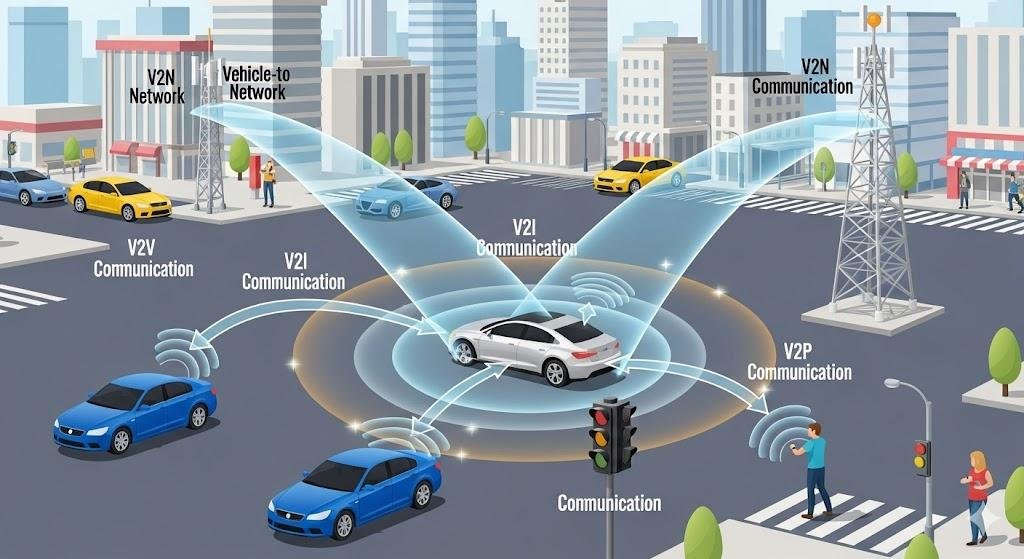
Decoding the Architecture
Vehicle-to-Everything technology represents far more than basic wireless connectivity. The system integrates multiple sensors, cameras, and advanced communication protocols including Wi-Fi, radio frequencies, LTE, and 5G cellular networks.
These components work together to enable vehicles to transmit and receive data beyond their immediate sensor range, creating what industry experts call “extended perception.” Currently, most vehicles lack interoperability—cars from different manufacturers cannot communicate unless specifically designed for the same proprietary networks.
This fragmentation severely limits potential safety benefits. The solution lies in widespread adoption of standardized cellular infrastructure, particularly 5G networks, which promise the low latency and high reliability required for critical transportation communications.
According to Rigby, director of sales at Rajant, a mobile network infrastructure company, implementing V2X Technology in Autonomous Driving at scale offers substantial advantages over relying exclusively on radar and LiDAR systems. Drivers can incorporate not only what their vehicle sensors detect but also predict how surrounding vehicles will respond to unexpected obstacles based on shared data.
Read more: Autonomous Vehicle Technology Trends: AI, Sensors & Hardware
The V2X Ecosystem Components
Understanding V2X demands analyzing its interconnected subsystems, each addressing specific communication scenarios that autonomous vehicles encounter:
| Component | Communication Type | Primary Applications |
|---|---|---|
| V2V (Vehicle-to-Vehicle) | Direct wireless exchange between cars | Platooning, cooperative maneuvering, sensor sharing, collision avoidance |
| V2I (Vehicle-to-Infrastructure) | Cars communicating with road systems | Smart traffic light coordination, hazard notifications, speed harmonization |
| V2P (Vehicle-to-Pedestrian) | Vehicles detecting vulnerable road users | Crosswalk safety alerts, warnings for cyclists and wheelchair users |
| V2N (Vehicle-to-Network) | Data transmission via cellular networks | Real-time traffic updates, remote diagnostics, emergency response coordination |
Vehicle-to-Vehicle (V2V)
V2V communication establishes wireless connections between automobiles without routing data through cell towers—a process called Sidelink. This enables real-time exchange of speed, location, and directional data. Many modern vehicles already incorporate rudimentary V2V features through lane change assistance and blind spot detection systems.
Advanced implementations support platooning, where vehicles travel in tight formations at high speeds, delivering improved aerodynamic performance, increased road capacity, and better fuel efficiency. New V2X systems allow vehicles to share raw or processed data from onboard LiDAR, cameras, and radars. This allows an autonomous vehicle to “see” around corners, through trucks, or behind buildings by utilizing data from another vehicle or a Smart Roadside Unit (RSU).
Cooperative overtaking maneuvers and sensor sharing further exemplify V2V capabilities, allowing vehicles to effectively “borrow” the cameras and LiDAR data from nearby cars.
Read more: 25 Technology Innovations Driving Business Growth
Vehicle-to-Infrastructure (V2I)
V2I extends connectivity to stationary elements like CCTV cameras, smart traffic signals, and environmental sensors. This communication pathway provides advanced hazard warnings, congestion alerts triggering route recalculation, and coordinated traffic light sequences. Emergency vehicles benefit particularly from V2I through automated green light corridors.
Public transportation networks integrate seamlessly, broadcasting real-time arrival information. Perhaps most transformative, V2I enables vehicles to “see around corners” by accessing stationary camera feeds and motion sensors positioned throughout the urban landscape.
Vehicle-to-Pedestrian (V2P)
V2P creates safety connections with wearable technology such as smartwatches and connected glasses. Crossing warnings protect vulnerable road users, particularly those with impaired sight or hearing. On unlit rural roads, V2P systems simultaneously alert drivers to pedestrians while providing tactile or audio notifications to the pedestrians themselves about approaching vehicles.
Read more: 5G Network: Everything You Need to Know
Vehicle-to-Network (V2N)
V2N routes communications through cellular infrastructure to application servers, enabling citywide route optimization based on real-time congestion data, over-the-air software updates, remote health monitoring, and automatic accident reporting to emergency services. Ambulances can stream patient vitals to hospitals, allowing medical teams to prepare appropriate treatment before arrival.
Transformative Benefits
The advantages of implementing V2X Technology in Autonomous Driving extend across multiple dimensions:
- Enhanced safety margins: Predictive collision avoidance systems leverage shared data from multiple vehicles, infrastructure sensors, and pedestrian devices to identify hazards before they enter the vehicle’s direct sensor range
- Operational efficiency: Optimized routing reduces congestion, while platooning and coordinated traffic management improve fuel economy and decrease travel times
- Economic impact: Reduced accident rates lower insurance costs and healthcare expenses while minimizing vehicle damage and infrastructure repair requirements
- Environmental gains: Smoother traffic flow and efficient routing decrease emissions and fuel consumption across transportation networks
Critical Challenges Confronting Deployment
Despite promising potential, V2X Technology in Autonomous Driving faces significant obstacles that delay widespread implementation. Miles Flamenbaum, co-founder of Acases, emphasizes sensor reliability concerns: “If that sensor isn’t properly prepared for adverse weather conditions or adverse operating conditions where it can widely operate without losing data, then you have a challenge.”
Since sensor accuracy directly determines V2X functionality and underpins autonomous vehicle operations, environmental resilience becomes non-negotiable. Data vulnerability presents another formidable challenge. V2X systems generate extensive information about driving patterns, locations, and behaviors.
Privacy advocates warn about potential surveillance, while cybersecurity experts identify risks including data theft, vehicle hijacking, and coordinated attacks on transportation infrastructure. Developing smooth encryption protocols and anonymization techniques remains essential for consumer acceptance.
Regulatory frameworks lag behind technological capabilities. Governments worldwide struggle to establish standardized communication protocols, spectrum allocation policies, and liability frameworks for V2X-enabled accidents. Without consistent regulations across jurisdictions, manufacturers face uncertain compliance landscapes that discourage investment.
Consumer awareness represents perhaps the most underestimated barrier. Most drivers remain unfamiliar with V2X capabilities and benefits, viewing the technology as unnecessary compared to existing advanced driver assistance systems. Education initiatives demonstrating tangible safety improvements and convenience enhancements will prove crucial for market adoption.
Read more: Wi-Fi 6 Vs. Wi-Fi 5: What are the differences?
The Road Ahead
Initial deployments of cellular vehicle-to-everything (CV2X) communication, introduced in 3GPP Release 14, demonstrate viable proof-of-concept implementations.
The transition toward 5G CV2X promises enhanced direct communication capabilities with dramatically reduced latency and increased connection density—critical requirements for dense urban environments where hundreds of vehicles, infrastructure nodes, and pedestrians must communicate simultaneously.
Short-range communications supporting V2V, V2I, and V2P interactions will mature alongside long-range cellular network components providing comprehensive traffic management across entire metropolitan regions. This dual-layer approach balances immediate safety-critical communications with strategic planning based on citywide data analysis.
V2X Technology in Autonomous Driving represents more than incremental improvement to existing systems—it fundamentally reimagines transportation as a cooperative ecosystem rather than millions of isolated vehicles making independent decisions. Success requires coordinated efforts across automotive manufacturers, telecommunications providers, infrastructure developers, regulators, and consumers.
The exponential growth potential demands comprehensive training programs preparing engineers and technicians for V2X system deployment and maintenance. As V2X Technology in Autonomous Driving transitions from experimental trials to mainstream implementation, the vision of safer, cleaner, and more efficient transportation networks moves closer to reality. The question no longer centers on whether V2X will transform driving, but rather how quickly stakeholders can overcome remaining challenges to unleash its full potential.
Read more: Top 10 Most Affordable Electric Vehicles
Frequently Asked Questions (FAQs)
Here are optimized answers to 5 of the most popular questions you definitely have in mind on V2X technology in autonomous driving.
What is V2X technology in autonomous vehicles?
V2X (Vehicle-to-Everything) enables autonomous vehicles to wirelessly communicate with other cars, infrastructure, pedestrians, and networks using sensors, cameras, and cellular connectivity for enhanced safety and efficiency.
How does V2X improve road safety?
V2X shares real-time data on speed, location, and hazards between vehicles and infrastructure, enabling predictive collision avoidance and extended perception beyond individual sensor range.
What’s the difference between V2V and V2I?
V2V (Vehicle-to-Vehicle) enables direct car-to-car communication without cell towers, while V2I (Vehicle-to-Infrastructure) connects vehicles with smart traffic lights, road sensors, and cameras.
Does V2X technology require 5G networks?
V2X functions on LTE but 5G significantly improves performance through ultra-low latency and high connection density, making it ideal for dense urban autonomous driving environments.
What are the main challenges facing V2X adoption?
Key obstacles include sensor reliability in adverse weather, cybersecurity vulnerabilities, inconsistent regulatory frameworks across jurisdictions, high infrastructure costs, and limited consumer awareness of benefits.
Related Contents:
- Autonomous Vehicle Technology Trends: AI, Sensors & Hardware
- 25 Technology Innovations Driving Business Growth
- Wi-Fi 6 Vs. Wi-Fi 5: What are the differences?
- 5G Network: Everything You Need to Know
- Top 5 Electric Scooters for Urban Commuters
- Top 10 Most Affordable Electric Vehicles
- Top 5 Electric Bikes For Daily Commuting