
Written by: Segun Akomolafe
Modern autonomous vehicles don’t actually rely on a single sensor to understand their environment. Instead, they employ Sensor Fusion Technology in Autonomous Vehicles;a simple approach that combines data from multiple sensors to create a comprehensive, reliable picture of the world around them. This integration of cameras, LiDAR, radar, GPS and inertial measurement units represents one of the most critical innovations enabling self-driving cars to operate safely in complex real-world conditions.
As autonomous driving evolves from laboratory prototypes to commercial deployments, sensor fusion has emerged as the backbone technology that makes safe navigation possible. A good knowledge of these systems will help you understand why no single sensor can handle autonomous driving alone and why the future of transportation depends on intelligent data integration.
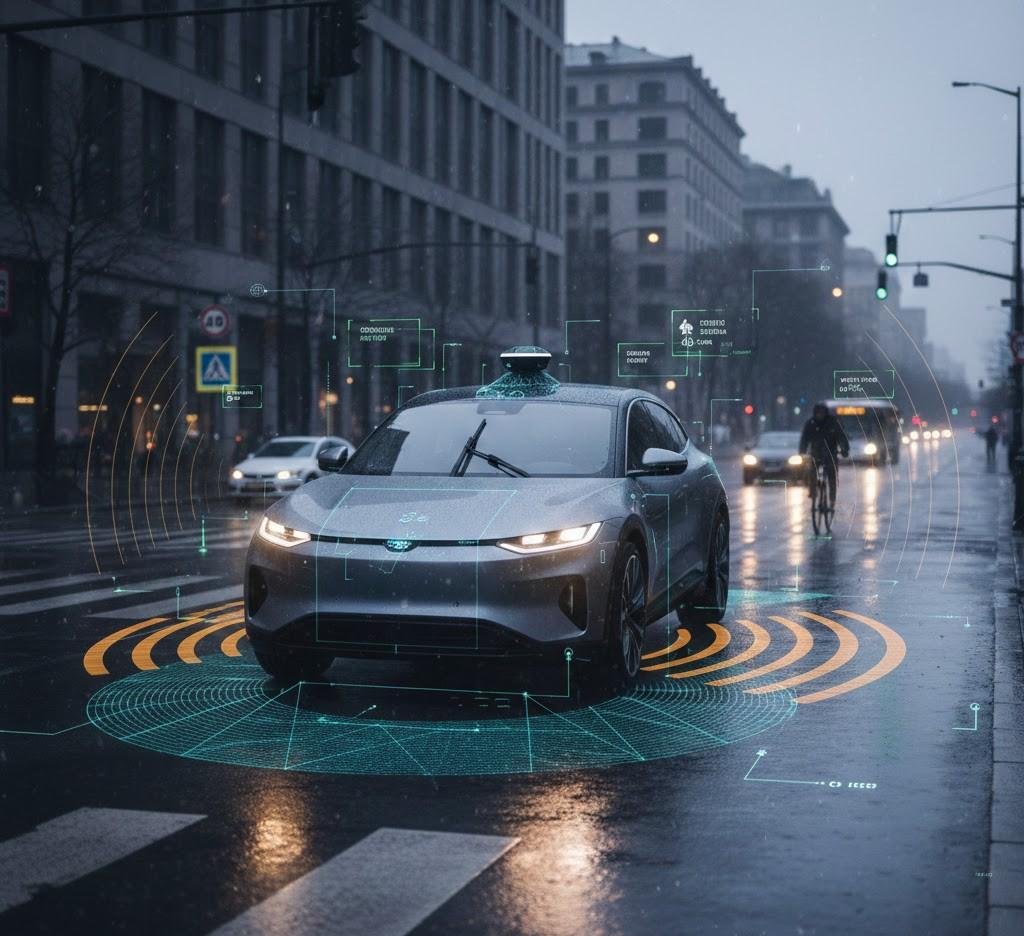
What Is Sensor Fusion Technology in Autonomous Vehicles?
Sensor fusion technology in autonomous vehicles refers to the computational process of combining sensory data from disparate sources to produce more accurate, complete, and reliable information than any single sensor could provide independently. Think of it as creating a detailed mosaic where each sensor contributes unique pieces that together form a complete picture.
Each sensor type excels in specific conditions but has inherent limitations. Cameras provide rich visual detail and color information but struggle in low light or adverse weather. LiDAR creates precise 3D point clouds but can be affected by rain and fog.
Radar penetrates weather conditions excellently but offers lower resolution. GPS provides absolute positioning but degrades in urban canyons and tunnels. By intelligently combining these complementary strengths, sensor fusion overcomes individual weaknesses.
The fusion process happens continuously in real-time, with advanced algorithms weighing each sensor’s reliability based on current environmental conditions. When visibility drops during heavy rain, the system automatically increases reliance on radar while reducing the weight given to camera data. This dynamic adjustment ensures consistent performance across diverse scenarios.
Core Sensor Technologies in the Fusion Stack
Multiple cameras positioned around the vehicle capture high-resolution visual data. These systems excel at identifying lane markings, traffic signals, road signs, and distinguishing between different object types.
Modern camera arrays typically include front-facing, rear-facing, and side-mounted units, creating 360-degree visual coverage. Advanced computer vision algorithms process this imagery to detect pedestrians, cyclists, vehicles, and static obstacles.
LiDAR (Light Detection and Ranging)
LiDAR sensors emit laser pulses that bounce off surrounding objects, measuring the time delay to calculate precise distances. This creates detailed 3D point clouds that represent the environment with centimeter-level accuracy. LiDAR operates independently of ambient lighting conditions, functioning equally well in darkness. The technology provides crucial depth perception and accurate distance measurements that complement camera data.
Radar Systems
Radar uses radio waves to detect objects and measure their velocity through Doppler shift. This technology performs exceptionally well in adverse weather conditions that challenge optical sensors. Radar excels at detecting metallic objects like vehicles and measuring their relative speed, making it invaluable for adaptive cruise control and collision avoidance. Long-range radar can track objects hundreds of meters away, providing early warning of potential hazards.
GPS and Inertial Measurement Units
High-precision GPS provides absolute positioning in open environments, while inertial measurement units (IMUs) track acceleration, rotation, and orientation. These systems work together through sensor fusion to maintain accurate positioning even when GPS signals degrade. IMUs bridge gaps in GPS coverage through dead reckoning, ensuring continuous localization.
Read more: Autonomous Vehicle Technology Trends: AI, Sensors & Hardware
How Sensor Fusion Algorithms Work
At its core, sensor fusion technology in autonomous vehicles employs good algorithms to integrate multi-sensor data streams. The most common approaches include Kalman filters, particle filters, and deep learning-based fusion networks.
Kalman filters predict the vehicle’s state based on previous measurements, then update these predictions as new sensor data arrives. This recursive approach efficiently combines noisy measurements from multiple sources into refined state estimates. Extended Kalman filters and unscented Kalman filters handle the nonlinear dynamics inherent in vehicle motion and sensor measurements.
Particle filters represent the vehicle’s possible states as a cloud of weighted particles. As new measurements arrive, particles inconsistent with observations receive lower weights while consistent ones are reinforced. This Monte Carlo approach handles multimodal distributions and highly nonlinear systems effectively.
Deep learning approaches train neural networks to learn optimal fusion strategies directly from data. These networks can discover complex patterns and relationships between sensor modalities that traditional algorithms might miss. Convolutional neural networks process camera imagery while point cloud networks handle LiDAR data, with fusion layers combining their outputs for unified scene understanding.
Read more: Best GPS Navigation Systems for Autonomous Vehicles
Sensor Fusion Approaches Comparison
Here’s a well optimized and detailed table that compares four different sensor fusion approaches in autonomous vehicles:
| Approach | Computational Cost | Accuracy | Best Use Case |
|---|---|---|---|
| Kalman Filter | Low | High for linear systems | Real-time tracking, GPS/IMU fusion |
| Particle Filter | Medium | High for nonlinear systems | Localization in complex environments |
| Deep Learning Fusion | High | Very high with sufficient data | Object detection, scene understanding |
Read more: Understanding V2X Technology in Autonomous Driving
Real-World Applications and Benefits
Sensor fusion technology in autonomous vehicles delivers tangible improvements across multiple operational domains. In urban environments with complex traffic patterns, pedestrians, and cyclists, fused sensor data enables reliable detection and tracking of multiple simultaneous objects.
The system maintains awareness of vehicles in adjacent lanes, pedestrians at crosswalks, and cyclists in blind spots;even when individual sensors have limited visibility. Highway driving benefits from sensor fusion’s ability to track vehicles hundreds of meters ahead while monitoring lane boundaries and road curvature.
Long-range radar detects distant vehicles, cameras read speed limit signs, and GPS confirms highway position, all working together to enable smooth, safe automated driving at highway speeds.
Adverse weather conditions showcase fusion technology’s crucial advantage. When heavy rain degrades camera and LiDAR performance, radar maintains object detection while IMU data preserves accurate motion tracking. The system automatically adjusts sensor weighting, ensuring continued safe operation when any single sensor would fail.
Parking scenarios require precise low-speed maneuvering in confined spaces. Ultrasonic sensors detect nearby obstacles at close range while cameras provide visual confirmation. This multi-sensor approach enables confident automated parking even in tight spaces where clearances measure just centimeters.
Challenges and Future Developments
Despite its benefits, sensor fusion technology in autonomous vehicles faces ongoing challenges. Now, you may ask “in what way?” Well, sensor calibration requires precise alignment between different sensor coordinate frames. Misalignment of even a few degrees can cause fusion algorithms to produce incorrect environmental representations. Maintaining calibration as vehicles experience vibration, temperature changes, and component aging demands robust calibration verification systems.
That’s not all, computational requirements present another constraint. The second challenge is that autonomous vehicles find it hard to process multiple high-bandwidth sensor streams in real-time while running sophisticated fusion algorithms.
Now, you may be wondering “why?” The simple answer is because of the significant computing power it requires. Modern autonomous vehicles employ multiple specialized processors like GPUs for deep learning, FPGAs for sensor preprocessing, and CPUs for general computations; all coordinated to meet strict latency requirements.
Future advancements will likely focus on more efficient neural network architectures that reduce computational overhead while improving accuracy. Sensor technologies continue evolving, with solid-state LiDAR promising lower cost and improved reliability.
Next-generation radar with higher resolution will provide better object classification. As these technologies mature, Sensor Fusion Technology in Autonomous Vehicles will become increasingly capable and cost-effective.
Read more: Autonomous Vehicle Safety & Testing Protocols
Frequently Asked Questions
Here are answers to the most popular questions about sensor fusion technology in autonomous vehicles.
Why can’t autonomous vehicles use just one sensor type?
Single sensors have inherent limitations; cameras struggle in darkness, LiDAR falters in heavy rain, radar provides low resolution. Sensor fusion combines multiple technologies to overcome individual weaknesses, ensuring reliable perception across all conditions.
How does sensor fusion improve safety?
Fusion provides redundancy if one sensor fails or encounters challenging conditions, others compensate. This multi-layered approach dramatically reduces the likelihood of perception failures that could cause accidents, making autonomous systems exponentially safer.
What happens if sensors disagree?
Advanced fusion algorithms employ conflict resolution strategies, weighing each sensor’s reliability based on current conditions. The system prioritizes the most trustworthy data sources and can flag inconsistencies that might indicate sensor malfunctions requiring attention.
Read more: 25 Technology Innovations Driving Business Growth
The Path Forward
Sensor fusion technology in autonomous vehicles represents the essential foundation enabling self-driving cars to navigate our complex world safely. By intelligently combining complementary sensor technologies, autonomous systems achieve the reliability and robustness required for real-world deployment.
As sensor hardware improves and fusion algorithms grow more sophisticated, autonomous vehicles will become increasingly capable of handling any driving scenario with better perception and decision-making.
The evolution continues as researchers and engineers push the boundaries of what is possible through sensor integration. From urban streets to rural highways, from clear days to blizzards, sensor fusion ensures autonomous vehicles can see, understand, and navigate the world around them with unprecedented accuracy and confidence.
Related Contents:
- Autonomous Vehicle Safety & Testing Protocols
- Understanding V2X Technology in Autonomous Driving
- Autonomous Vehicle Technology Trends: AI, Sensors & Hardware
- Best GPS Navigation Systems for Autonomous Vehicles
- Top 5 Electric Scooters for Urban Commuters
- Top 5 Electric Bikes For Daily Commuting
- Top 10 Most Affordable Electric Vehicles
- 5G Network: Everything You Need to Know
- 25 Technology Innovations Driving Business Growth
- Autonomous Vehicle Systems & Levels