
Written by: Segun Akomolafe
Wondering how you can invest early and earn the most possible returns? The sooner you begin investing, the better, as it may have a tremendous effect on how well you can become wealthy. Time and compound interest have a compounding effect, which leaves a late entrant with no possibility to grow exponentially, regardless of the amount of capital put in.
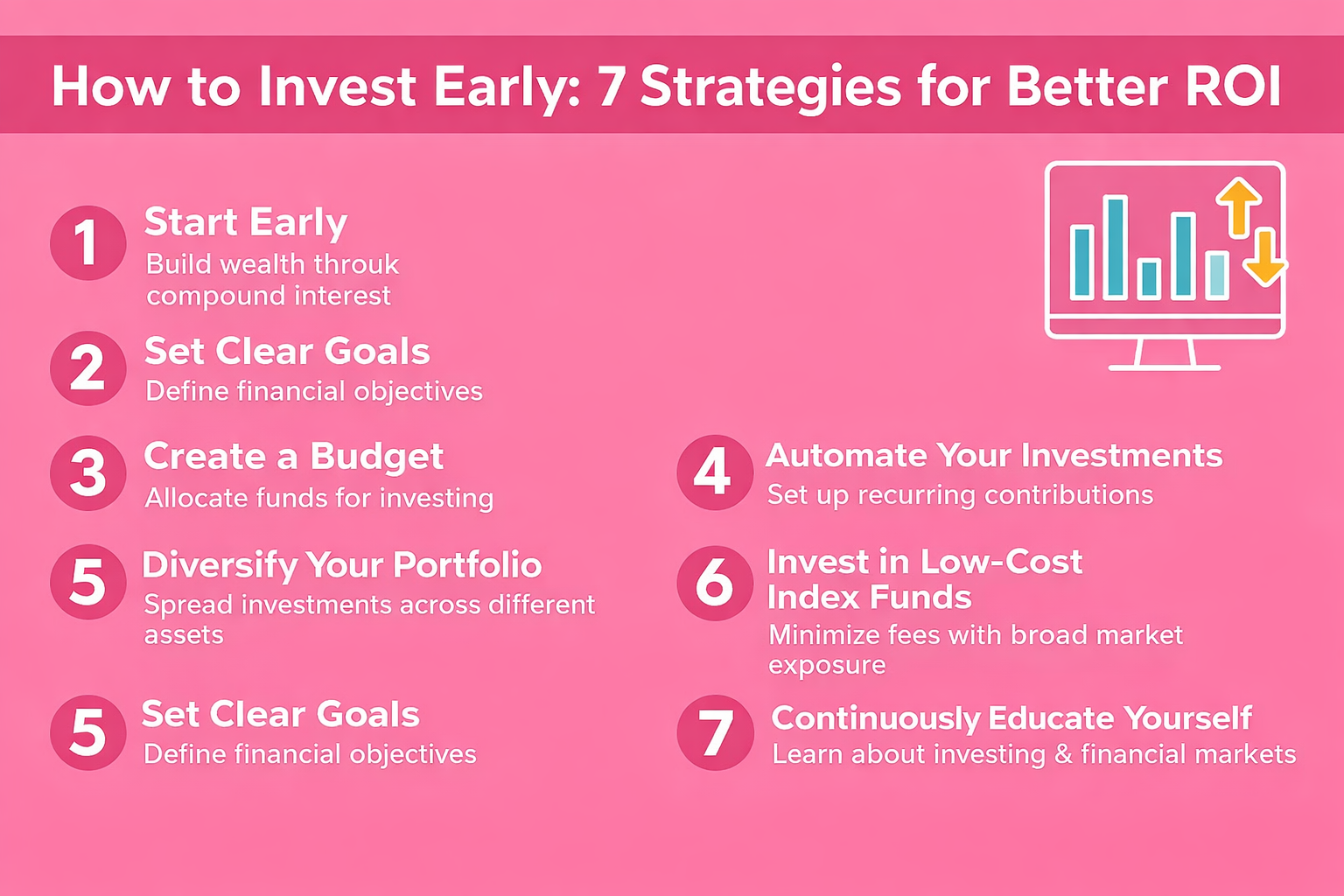
This is a detailed guide which discloses seven effective tips and tricks on how to invest early and get the best returns. Regardless of your age, first paycheck or the fact that you are finally ready to take charge of your financial future, the below actionable insights will guide you towards a significant future wealth. Learning to invest at a young age is not simply about picking stocks but rather about building the proper mentality, strategies and habits that will make you successful.
1. Begin with Company-Sponsored Payment Plans
The very first place to get to know how to invest early is with the payment plan of your employer. The majority of companies provide 401 (k) or any other similar plan with matching contributions which are basically free money that builds your wealth faster. A significant contribution to grab the full employer match incurs an instant 50-100% investment payoff before the market gains.
Outside the match, these plans are tax-saving plans that increase your returns. Conventional 401(k) investments decrease your present taxable earnings, whereas Roth alternatives enable tax free investment and withdrawals during retirement. Even a small portion of your payment (say 3-5% of it in your twenties) can be six or seven figures by the time you can retire through decades of compounding.
Read more: How to Pay Off Your Most Important Bills First: A Step-by-Step Priority Guide
2. Open Roth IRA to Grow Tax-Free
Roth IRA is one of the most efficient instruments of young investors who are learning how to invest early. In contrast to the conventional saving-retirement plans, Roth IRAs welcome post-taxes but provide full tax-free growth and retirement withdrawals. This tax-free growth is simply off-the-scale when you have several decades before retirement.
Roth IRAs are of great benefit to young investors, who have lower tax brackets. You contribute taxes today at a fairly low rate, and you can get tax free draw later on when you might be in an even higher bracket. The contribution limit could be 7,000 per year, giving one a lot of space to accumulate wealth. Also, Roth IRAs have quite a special feature that makes them great investment options both as retirement and emergency savings – you can withdraw your contribution at any time and will not be punished.
3. Adopt Index Funds and ETFs as a way of Diversification
Index funds and exchange-traded funds (ETFs) must make up your investment basis when you learn how to invest early. These cars offer instant diversification of hundreds or thousands of companies and this is a huge cut on risk compared to picking stocks individually. A number of studies have always reported that low cost index funds tend to perform better than the actively managed funds in the long run when they are factoring in the fees.
These are diversification strategies to consider:
- Total market index funds reflect the performance of the entire stock market with extremely low cost ratios of less than 0.05%.
- Target-date funds, which automatically reallocate your assets as you near retirement, eliminating the scenario of rebalancing guesswork.
- International index funds which have exposure to growth opportunities outside the US markets.
- Bond index funds that provide stability and income to your portfolio as you get a lot of wealth.
The certainty of dollar-cost averaging is the major benefit of early investors. You can invest on a regular basis whether the market is performing well or poorly and buy more shares when the market is performing poorly and fewer when the market is performing well and this means that you will be paying a lower average price over time.
Read more: How to Live Within Your Means
4. Automate Your Contributions in Investment
Automation gets rid of the behavioral barriers that render consistent investing impossible. Automatic transfers into your investment accounts through your checking account will guarantee that you are investing before you even get an opportunity to spend. It is a pay yourself first strategy that makes investing not a choice, but a necessity, as rent or electricity is.
Investment market automation is not a problem with modern investment platforms. The vast majority of brokerages and robots are able to make recurring investments on a daily, weekly, or monthly schedule. Even minor amounts invested automatically will accumulate in a great way–by age 25 a person can invest as small as $200 per month and by the age of 65 they could have accumulated to more than half a million with the average market returns.
The psychological advantage is equally significant: with automation, the element of emotion is eliminated when making investment decisions, allowing you to not time the market and not hesitate when the market is volatile.
| Automation Frequency | Advantage |
|---|---|
| Daily | Maximum dollar-cost averaging, smoothest market entry |
| Weekly | Balances convenience with regular investing |
| Bi-weekly | Aligns with most payday schedules |
| Monthly | Simplest approach, matches most bills |
5. Reduce Investment Costs and expenses
Learning how to invest early is to know that fees accumulate in a negative manner just like returns accumulate positively. A 1% fee per annum will cut your portfolio value by more than 25 per cent over 30 years versus a 0.10 fee. And when you have 30 years to retirement, just a basis point of fees counts a lot.
Concentrate on three types of fees, which includes expense ratios on mutual funds and ETFs, trading commissions, and advisory fees. Select funds that have expense ratios of less than 0.20, use brokerages that charge no commissions and look to low-cost automated advisors as an alternative to more traditional financial advisors in the event that you are comfortable with automated management.
Read more: How to Get Started with DeFi: A Beginner’s Guide to Earning Passive Income
6. Raise the Rate of Increase in Your Investment Per Annum
The possibility of raising the contribution rates with the rise in income is a strategy that can be used by early investors. It can be affordable to start at 5 percent of salary but the actual increase in wealth happens when you decide to increase the percentage by 1-2 percent a year.
Using this method, time and enhanced capital are used to maximize the compound growth. When combined with high-deductible plans, health savings accounts provide three tax benefits: deductible contributions, tax-free growth, and tax-free withdrawals for lifetime qualified medical expenses.
Automatic escalation provisions are now provided in most retirement plans by employers, which raises the contribution rate by a pre-defined percentage annually. Or promise to invest half or less of all increases or bonuses. The higher your income will be, say 40,000 to 60,000 to 80,000 during your career, the higher should be your rate of investment, which is 5 percent of your income, 10 percent, 15 percent, or more.
This slow-paced method accumulates a lot of wealth without the need to make a radical lifestyle change. No-fee trading platforms have done away with transaction costs, so young investors can now create diverse portfolios by making small monthly contributions without stressing over fees eating into their returns.
7. Keep Long-term View During Market Volatility
The last critical component of the question of how to invest early is the mental resilience to remain investing even in the face of market crashes that are bound to happen. The initial investors stand on tremendous grounds; they have time to absorb the crashes. A market reduction of 30 percent at age 25 is a buying opportunity and not a crisis when you have 40 years to retirement.
Past experience is educational—all major market crashes in history, such as the Great Depression, the 2008 financial crisis and the 2020 pandemic crash, turned out to be recovered by new highs. Those investors who retained their investments in the bad times acquired cheaper prices putting them in a determination of wealth expansion.
On the other hand, the individuals who sold their investments in panic or terminated were permanently deprived of their investments and later recoveries. The time period of your investment determines your strategy: the amount of time you have to stay invested would mean that short-term fluctuations do not matter at all on the end of your success.
Read more: Best DeFi Wallets Comparison Guide: Features, Types, User Experience, and FAQs
Frequently Asked Questions on How to Invest Early
The following are the responses to frequently asked questions regarding early investing plans.
How much should I invest at a young age?
Most brokerages require an initial investment of as low as $50-100 per month. Fractional shares are now available on a host of platforms with no minimum investment requirements. The thing is that one has to begin right away instead of waiting to gain more and more.
Is it advisable to settle debts early in life before understanding how to invest?
Invest only at a high interest rate of above 7-8 percent. Nevertheless, during retirement plans always take the full employer matching- it is guaranteed returns. Strike a balance between the two by paying minimum debts to reach as much as possible invested in maximizing free employer money.
Which investment approach can best suit total beginners?
Target-date funds are the easiest to use. These funds automatically rebalance the assets according to your retirement date, which is diversified in an instant and professionally managed at an effort of minimum. They also suit beginners in their hands-off investments.
Conclusion
Learning how to invest early is probably one of the best financial skills you will ever have. These seven strategies described below, which are a leverage of employer plans, Roth IRA, index funds, automation of contributions, reducing fees, raising investment rates, and long-term perspective, make up an overall structure of accumulating a lot of wealth in the long term.
The good benefit of starting early can hardly be overemphasized. Someone who invests 500 dollars a month when he is 25 years old will be wealthy in comparison to someone who is 35, and who invests 1,000 a month but who puts in less total capital. Being in the market is better than timing the market and compound interest rewards those who begin first.
Open an account and make automatic contributions and resolve this investment habit by investing whether the market is good or bad. The future you are about to shape will be grateful that you will be disciplined and foresightful in what you do. There is no right time or brilliant brain to be financially independent, but one must begin early and be regular in his/her actions.
Related Contents
- Debt Snowball vs. Avalanche Method: Which Pays Off Debt Faster?
- How to Pay Off Your Most Important Bills First: A Step-by-Step Priority Guide
- How to Get Started with DeFi: A Beginner’s Guide to Earning Passive Income
- How to Live Within Your Means
- Best DeFi Wallets Comparison Guide: Features, Types, User Experience, and FAQs
- How to Create a Debt-Free Budget: 5-Key Strategies
- Savings Vs. Investing: Which one Should You Choose?
- How to Pay Off Debt Quickly
- Basic Financial Concepts You Should Understand
- Reserve Fund vs. Savings Account: What’s the Difference?