
Written by: Segun Akomolafe
Digital marketing for small businesses has become essential for survival and growth in today’s competitive marketplace. Small business owners often face unique challenges—limited budgets, minimal staff, and the constant pressure to deliver immediate results while building long-term brand equity. The good news is that digital marketing levels the playing field, allowing small businesses to compete effectively against larger competitors through strategic, cost-effective online initiatives.
This comprehensive guide provides small business owners with actionable strategies to launch and scale digital marketing for small businesses without overwhelming resources or technical expertise. Whether you’re a local retailer, service provider, or online entrepreneur, understanding which digital channels deliver the best return on investment and how to maximize limited budgets will transform your marketing from an expense into a growth engine that generates measurable results.
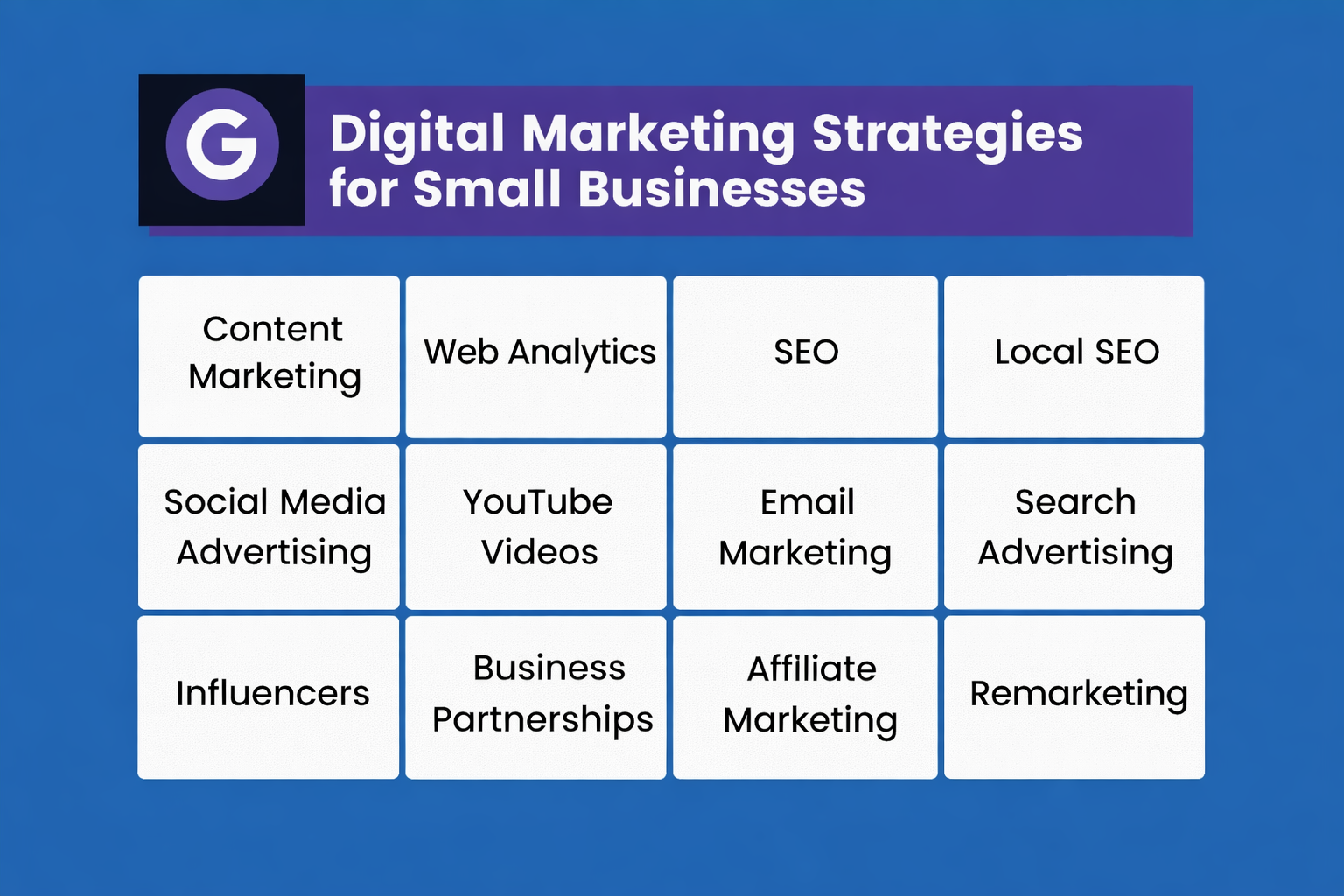
Why Digital Marketing Matters for Small Businesses
Digital marketing for small businesses involves using online channels like websites, social media, email and search engines to build brand awareness, engage customers, and drive sales cost-effectively. The shift to digital marketing has fundamentally changed how consumers discover, evaluate, and purchase from businesses.
Over 97% of consumers now search online for local businesses, and 88% of smartphone users who search for local information visit or call a business within 24 hours. For small businesses, this presents unprecedented opportunities to reach customers actively looking for their products or services.
Traditional advertising channels like print, radio, and television require substantial budgets and offer limited targeting capabilities. Digital marketing for small businesses provides precise audience targeting, real-time performance tracking, and the flexibility to adjust campaigns based on data. You can start with minimal investment, test what works, and scale successful strategies—advantages that were impossible with traditional marketing methods.
Read more: What is Digital Marketing?
Building Your Digital Marketing Foundation
Success with digital marketing for small businesses begins with establishing a strong foundation. Your website serves as the hub of all digital activities—the destination where traffic from social media, search engines, and advertising campaigns ultimately converts. Ensure your website loads quickly, displays properly on mobile devices, clearly communicates your value proposition, and makes it easy for visitors to take action.
Beyond your website, claim and optimize your Google Business Profile. This free listing appears in local search results and Google Maps, making it essential for businesses serving specific geographic areas. Complete every section thoroughly, add high-quality photos, encourage customer reviews, and keep information current. A well-optimized profile significantly improves local visibility without requiring paid advertising.
Read more: Influencer Marketing You Need to Know
Essential Digital Assets for Small Businesses
Small business owners basically make use of AI SEO, local Google Maps tactics and viral social hacks to triple leads for under $500/month. Every small business needs these foundational digital assets before launching marketing campaigns:
- Mobile-responsive website with clear calls-to-action and fast loading speeds
- Google Business Profile optimized with complete information and regular updates
- Professional email addresses using your domain name (not free providers)
- Social media profiles on platforms where your target customers are active
- Email marketing platform to capture and nurture leads systematically
- Analytics tracking installed on your website to measure performance accurately
Read more: How to Create a Digital Marketing Strategy
Choosing the Right Digital Marketing Channels
Not every digital marketing channel makes sense for every small business. Success requires focusing resources on channels that align with your audience, business model, and available budget. Local service businesses benefit tremendously from local SEO and Google Business Profile optimization, while e-commerce stores might prioritize social media advertising and email marketing.
The most effective approach to digital marketing for small businesses typically combines two or three complementary channels rather than spreading thin across many platforms. Start with channels offering the best return on investment for your specific industry, master them thoroughly, then expand to additional channels as resources allow. This focused strategy delivers better results than mediocre execution across numerous platforms.
| Business Type | Priority Channels | Why It Works |
|---|---|---|
| Local Services | Local SEO, Google Business Profile | Captures high-intent local searches |
| E-commerce | Social media ads, Email marketing | Drives direct sales and repeat purchases |
| B2B Services | LinkedIn, Content marketing, SEO | Builds authority and generates leads |
Cost-Effective Channel Strategies
Budget constraints require small businesses to prioritize channels offering the best combination of reach, targeting, and affordability. Organic social media posting costs nothing but time, making it ideal for businesses with more time than money. Search engine optimization delivers long-term value without ongoing advertising costs, though results take months to materialize.
Email marketing consistently delivers the highest ROI among digital channels, averaging $42 return for every dollar spent. Building an email list and nurturing subscribers with valuable content creates a direct communication channel you own—unlike social media followers that platform algorithms control. For digital marketing for small businesses with limited budgets, email marketing often provides the most predictable, scalable results.
Read more: 10 Types of Digital Marketing
Budget Allocation and Resource Management
Small business marketing budgets typically range from 5-10% of gross revenue, though newer businesses often allocate 10-20% to build awareness quickly. Within that budget, balance spending between paid advertising for immediate results and organic strategies that build sustainable long-term value. A common approach allocates 60% to proven channels, 30% to growth opportunities, and 10% to experimental tactics.
Time represents another critical resource for digital marketing for small businesses. Most small business owners wear multiple hats, making consistent marketing execution challenging. Consider outsourcing specialized tasks like graphic design, content writing, or paid advertising management while handling activities like social media engagement and customer email responses internally. This hybrid approach maximizes both budget efficiency and expertise.
| Budget Category | Recommended Allocation |
|---|---|
| Paid Advertising (Google, Facebook, etc.) | 30-40% for immediate traffic and leads |
| Content Creation and SEO | 25-35% for long-term organic growth |
| Email Marketing and Automation | 15-20% for lead nurturing and retention |
| Tools and Software | 10-15% for analytics and management platforms |
Read more: The Ultimate Guide to Growing Your Online Business
Creating Content That Converts
Content marketing forms the backbone of successful digital marketing for small businesses. Unlike paid advertising that stops delivering results when you stop spending, quality content continues attracting visitors and generating leads indefinitely. Focus on creating content that answers customer questions, solves problems, and demonstrates expertise rather than simply promoting products.
Small businesses often achieve better results with fewer, higher-quality content pieces than high-volume, low-quality output. One comprehensive guide that thoroughly addresses a topic generates more traffic and conversions than ten superficial posts. Prioritize depth over frequency, ensuring each piece provides genuine value that positions your business as the trusted authority in your niche.
Read more: How to Measure Digital Marketing Success: Essential Metrics and Analytics Guide
Measuring Success and Optimizing Performance
Effective digital marketing for small businesses requires tracking the right metrics and adjusting based on data. Focus on metrics that directly impact revenue—conversion rate, customer acquisition cost, and return on investment—rather than vanity metrics like follower counts or page views. Google Analytics provides free, comprehensive website tracking, while platform-specific analytics reveal social media and advertising performance.
Establish monthly review processes to evaluate what’s working and what needs adjustment. Compare performance against previous periods and industry benchmarks, identify top-performing content and campaigns, analyze conversion funnel drop-off points, and test improvements systematically. This data-driven approach transforms marketing from guesswork into a predictable growth system.
For long-term growth, use AI for personalization, implement Answer Engine Optimization (AEO), emphasize short-form video, and prioritize first-party data. According to industry analysts, this change addresses the evolution of search behavior and the establishment of customer trust.
| Metric | What to Track | Target Benchmark |
|---|---|---|
| Website Traffic | Monthly unique visitors growth | 15-25% month-over-month |
| Conversion Rate | Percentage completing desired actions | 2-5% for most industries |
| Email Open Rate | Engagement with email campaigns | 20-25% average across industries |
| Social Engagement | Likes, shares, comments per post | 1-3% of total followers |
Read more: How to Measure Digital Marketing Success
Frequently Asked Questions
Here are the top rated answers to the most frequently asked questions on digital marketing for small businesses.
How much should small businesses spend on digital marketing?
Allocate 5-10% of gross revenue for established businesses, or 10-20% for newer businesses building awareness. Start conservatively, measure ROI carefully, and scale the budget based on proven results. Put SEO, email, and targeted ads at the top of your list of channels because they have the highest conversion rates. Make sure that every dollar you spend helps you build your online presence, get new customers, and build your brand equity over time.
Which digital marketing channel delivers the best ROI for small businesses?
Email marketing consistently delivers the highest ROI at $42 per dollar spent. However, the best channel depends on your business type, target audience, and available resources for execution. Finally, a combination of email marketing campaigns and social media marketing is the most sustainable and effective strategy for growth. This helps to expand your brand’s long-term online income potential.
Can small businesses compete with large companies in digital marketing?
Absolutely. Digital marketing levels the playing field through precise targeting, niche specialization, and authentic customer relationships that large corporations struggle to replicate. Focus beats scale in digital competition.
Conclusion
Success with digital marketing for small businesses requires strategic focus rather than unlimited resources. By building strong foundations, choosing appropriate channels, allocating budgets wisely, and measuring performance consistently, small businesses create sustainable competitive advantages. The strategies outlined in this guide provide a roadmap for launching and scaling digital marketing initiatives that generate measurable returns without overwhelming budgets or teams.
Start with one or two channels aligned with your business model and target audience. Master those thoroughly before expanding. Remember that consistency beats perfection—regular execution of solid fundamentals outperforms sporadic attempts at advanced tactics. Digital marketing for small businesses succeeds through persistent effort, continuous learning, and willingness to adapt based on performance data. The playing field has never been more level for small businesses willing to embrace digital strategies systematically.
Related Contents:
- What is Digital Marketing?
- How to Create an Influencer Marketing Strategy for Your Business
- 10 Types of Digital Marketing
- How to Measure Influencer Marketing ROI
- Micro-Influencers vs. Mega-Influencers: Which Delivers Better ROI?
- Influencer Marketing You Need to Know
- How to Create a Digital Marketing Strategy
- The Ultimate Guide to Growing Your Online Business
- How to Measure Digital Marketing Success: Essential Metrics and Analytics Guide
- How to Scale Your Influencer Marketing Business