
Written by: Segun Akomolafe
The world of decentralized finance has opened unprecedented opportunities for everyday investors to generate passive income without traditional intermediaries. This guide on how to get started with DeFi will walk you through everything you need to know—from understanding basic concepts to implementing proven strategies that can help grow your crypto holdings safely and sustainably.
Whether you’re holding Bitcoin, Ethereum, or stablecoins, letting your assets sit idle means missing out on potential returns. This guide demystifies DeFi earning mechanisms and shows you exactly how to put your crypto to work. By the end, you’ll understand which strategies align with your risk tolerance and financial goals.
What Is DeFi Passive Income?
DeFi passive income refers to cryptocurrency earnings generated through automated smart contract protocols without active trading. Unlike traditional savings accounts controlled by banks, DeFi protocols operate autonomously on blockchain networks, distributing yields directly to participants.
These earnings come from various sources: transaction fees from decentralized exchanges, interest from lending protocols, rewards from liquidity provision, and staking incentives from proof-of-stake networks. The key advantage is maintaining full custody of your assets while earning, your crypto never leaves your wallet’s control.
Read more: Best DeFi Wallets Comparison Guide: Features, Types, User Experience, and FAQs
Understanding Different DeFi Earning Strategies
When learning how to get started with DeFi, understanding your earning options is crucial. Each strategy offers different risk-reward profiles, time commitments, and complexity levels. Here’s a comprehensive breakdown:
| Strategy | Expected APY | Risk Level | Best For |
|---|---|---|---|
| Staking | 5-20% | Low-Medium | Long-term holders |
| Lending | 3-12% | Low | Conservative investors |
| Liquidity Pools | 10-100%+ | Medium-High | Active managers |
| Yield Farming | 20-500%+ | High | Experienced users |
| Stablecoin Yields | 5-15% | Low-Medium | Risk-averse beginners |
Staking: The Foundation of Passive Income
Staking represents the simplest entry point for DeFi beginners. You lock your proof-of-stake cryptocurrencies (like Ethereum, Cardano, or Polkadot) in network validators that secure the blockchain. In return, you receive newly minted tokens as rewards, typically ranging from 5-20% annually depending on the network.
Most major wallets now offer built-in staking features, making the process as simple as clicking a button. The main consideration is lock-up periods: some networks require your assets to remain staked for weeks or months, during which you cannot access or trade them.
Lending Protocols: Earn Interest Like a Bank
Lending platforms like Aave and Compound allow you to deposit crypto assets and earn interest from borrowers. Rates fluctuate based on supply and demand but typically range from 3-12% for major cryptocurrencies and stablecoins. Your funds remain accessible, you can withdraw anytime without penalties.
The beauty of DeFi lending is automatic compounding. Interest accrues every block (approximately every 13 seconds on Ethereum), meaning your earnings immediately start generating their own returns without manual reinvestment.
Platforms like Beefy Finance or Yearn.fi basically use AI-driven smart contracts to automatically move your funds to the pool that actually has the highest safe return at that moment.
Read more: How to Create a Debt-Free Budget: 5 Key Strategies
Liquidity Provision: Advanced Earning Potential
Providing liquidity to decentralized exchanges (DEXs) like Uniswap or PancakeSwap offers higher returns but introduces impermanent loss risk. You deposit equal values of two tokens into a trading pool, and earn a portion of trading fees whenever people swap those tokens.
Beyond simple staking, users now use protocols like EigenLayer to basically restake their already staked ETH to secure additional networks, earning multiple yield streams from a single asset.
Returns vary dramatically, from 10% on stable pairs to over 100% on volatile new tokens. However, if token prices diverge significantly from your entry point, you might have been better off simply holding. This makes liquidity provision best suited for experienced users who understand the calculation.
Step-by-Step Guide to Your First DeFi Earnings
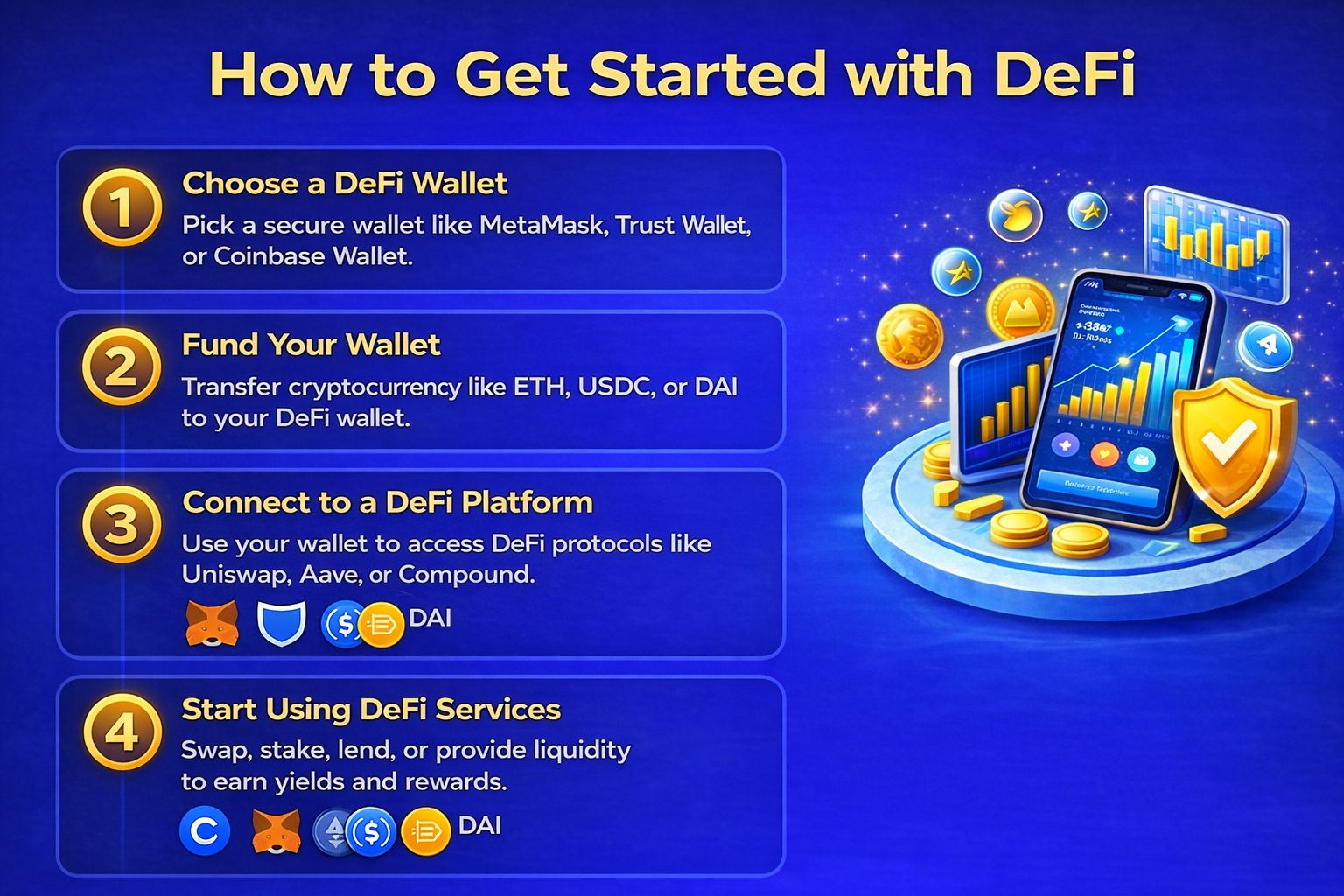
This practical walkthrough for how to get started with DeFi takes you from zero to earning in five manageable steps:
Step 1: Set Up Your DeFi Wallet – Download a non-custodial wallet like MetaMask or Trust Wallet. Write down your recovery phrase on paper and store it securely, this is your only backup if you lose device access. Never share this phrase with anyone or store it digitally to protect your crypto assets from online hacking threats completely.
Step 2: Fund Your Wallet – Purchase cryptocurrency from a centralized exchange (Coinbase, Binance, or Kraken) and transfer it to your wallet address. Start small, $100-$500 is enough to learn without significant risk. Keep some extra tokens for gas fees (transaction costs).
Step 3: Choose Your First Strategy – For absolute beginners, stablecoin lending offers the perfect starting point. Deposit USDC or DAI into Aave or Compound. You’ll earn 5-10% annually with minimal volatility risk since stablecoins maintain dollar parity.
Step 4: Connect to the Protocol – Visit the protocol’s official website (verify the URL carefully to avoid phishing). Click ‘Connect Wallet’ and approve the connection in your wallet. The protocol will request permission to interact with your tokens—this is normal but review what you’re approving.
Step 5: Deposit and Start Earning – Select your deposit amount, confirm the transaction, and pay the gas fee. Your earnings begin immediately and compound automatically. Most protocols display your accrued interest in real-time on their dashboard.
Read more: Where to Keep Your Reserve Fund: Best Accounts Compared
Managing Risks in DeFi Passive Income
While DeFi offers compelling returns, understanding and managing risks separates successful participants from those who lose funds. Every strategy carries unique vulnerabilities that require active mitigation:
| Risk Type | Description | Mitigation Strategy |
|---|---|---|
| Smart Contract Risk | Code vulnerabilities can be exploited | Use audited, established protocols only |
| Impermanent Loss | Price changes reduce liquidity pool returns | Stick to correlated or stable pairs |
| Liquidation Risk | Borrowed positions get closed during crashes | Maintain high collateral ratios (>200%) |
| Rug Pulls | Developers abandon projects with user funds | Avoid anonymous teams and new projects |
| Network Congestion | High gas fees eat into smaller profits | Use Layer 2 solutions or alternative chains |
Never invest more than you can afford to lose. Diversify across multiple protocols and strategies rather than concentrating everything in one place. Research protocol track records, audit reports, and total value locked (TVL) as indicators of reliability. The most attractive yields often carry the highest risks—if returns seem too good to be true, they usually are.
Read more: Debt snowball Vs. Avalanche method; which pays off debt faster?
Top DeFi Platforms for Beginners This Year
Choosing reputable platforms is essential when implementing how to get started with DeFi. These established protocols offer the best combination of safety, user experience, and reasonable returns:
| Platform | Primary Function | Beginner-Friendly | Typical APY | Supported Networks |
|---|---|---|---|---|
| Aave | Lending/Borrowing | Yes | 3-8% | Ethereum, Polygon, Arbitrum |
| Lido | Staking | Yes | 3-5% | Ethereum, Polygon, Solana |
| Uniswap | Liquidity Pools | Medium | 10-50% | Ethereum, Polygon, Base |
| Curve Finance | Stablecoin Swaps | Medium | 5-20% | Ethereum, Polygon, Arbitrum |
| Rocket Pool | ETH Staking | Yes | 3-5% | Ethereum |
Aave dominates DeFi lending with over $10 billion in total value locked and a spotless security record since 2020. Lido revolutionized Ethereum staking by allowing liquid staking—you receive stETH tokens representing your staked ETH that can still be used in other DeFi protocols. Uniswap invented the automated market maker model and processes billions in daily trading volume.
Read more: How to Track Your Monthly Expenses: A Complete Guide to Financial Control
Maximizing Your DeFi Returns
Once comfortable with basics, advanced techniques can significantly boost earnings. Compounding strategies involve regularly harvesting rewards and redeploying them into the same or different protocols. Layer 2 networks like Arbitrum and Optimism offer identical protocols with 95% lower gas fees, making frequent compounding economically viable.
Yield aggregators like Yearn Finance automatically move your funds between protocols to capture the highest available returns. While convenient, they add another smart contract layer and charge performance fees (typically 10-20% of profits). For holdings above $10,000, the automation often justifies the cost.
Prioritize wallets with Account Abstraction for social recovery—no more lost seed phrases. Ensure multi-chain support for seamless asset movement across Layer 2s and integrated AI-driven real-time fraud alerts.
Tax efficiency matters—DeFi transactions generate taxable events in most jurisdictions. Keep detailed records of deposits, withdrawals, and claimed rewards. Some countries treat staking rewards as income, while others tax only upon sale. Consult a crypto-savvy accountant to optimize your strategy.
Common Mistakes Beginners Make
New DeFi users frequently fall into predictable traps. Chasing unsustainably high yields leads to rug pulls and losses—legitimate 20% APY on stablecoins is strong; 2,000% APY is almost certainly a scam. Failing to account for gas fees can eliminate profits on small positions; always calculate whether expected earnings exceed transaction costs.
Never grant unlimited token approvals to untrusted contracts. Most protocols request permission to spend infinite tokens for convenience, but this creates vulnerabilities if the protocol gets hacked. Manually set approval amounts or revoke unnecessary approvals using tools like Revoke.cash.
Ignoring protocol updates and governance proposals can cost you. Major changes sometimes affect yields, introduce new features, or modify risk parameters. Join protocol Discord servers or follow their Twitter accounts to stay informed about developments affecting your positions.
Read more: Secured vs Unsecured Loans: A Deep Dive into Complete Guide
FAQs on How to Get Started with DeFi
Here’s a detailed explanation to the most frequently asked questions on the simplest way to get started with DeFi and earn passive income.
How much money do I need to start earning passive income with DeFi?
You can start with as little as $100, though $500-$1,000 makes more sense to cover gas fees while maintaining meaningful returns. You can first save the money in a reliable online bank. Then, move the money to your crypto wallet. Layer 2 networks reduce costs significantly for smaller positions. Focus on researching protocols, be aware of impermanent losses, diversify through different platforms, and use secure wallets to safeguard your initial capital for future growth.
Is DeFi passive income truly passive or does it require constant management?
To maximize your crypto gains, you need to monitor the market trends. These includes two techniques are really passive because they involve depositing once and earning automatically through the use of smart contracts. Providing liquidity involves keeping track of the problem of impermanent risk, while yield farming involves active management. To increase the annual percentage yield of your portfolio, there is need for you to understand security and market volatility.
What happens if a DeFi protocol gets hacked or fails?
Unlike banks, DeFi deposits lack FDIC insurance. If exploited, funds may be permanently lost. Stick to audited protocols with insurance options like Nexus Mutual. Diversification across platforms reduces catastrophic loss risk from potential exploits, ensuring better security for your decentralized finance investments. By understanding these dynamics, investors can construct sustainable portfolios, sidestep expensive smart contract risks, and optimize total returns.
Conclusion
Understanding how to get started with DeFi empowers you to take control of your financial future through decentralized protocols. Start conservatively with stablecoin lending or established staking protocols, gradually expanding into more advanced strategies as your knowledge grows.
The key to sustainable DeFi earnings is patience, education, and risk management. Never invest funds you cannot afford to lose, always research protocols thoroughly, and maintain realistic expectations about returns. The DeFi ecosystem continues evolving rapidly—staying informed through reputable sources helps you adapt strategies and capitalize on new opportunities while avoiding emerging threats.
In a nutshell, a good advice for liquid staking is that you should consider using platforms like Stader Labs to stake assets while receiving a liquid token because it will let you use those assets in other DeFi protocols simultaneously. For beginners, it is generally better to focus on high-yield stablecoin pairs (e.g., USDC/DAI) on platforms like Curve Finance to avoid volatility.
Your journey into getting started with DeFi begins with a single step. Set up that wallet today, start small, and let the power of decentralized finance work for you.
Related Contents
- Debt Snowball vs. Avalanche Method: Which Pays Off Debt Faster?
- Best DeFi Wallets Comparison Guide: Features, Types, User Experience, and FAQs
- How to Create a Debt-Free Budget: 5 Key Strategies
- How to Pay Off Debt Quickly
- A Deep Dive into Secured vs Unsecured Loan
- Reserve Fund vs. Savings Account: What’s the Difference?
- Savings Vs. Investing: Which One Should You Choose?
- Basic Financial Concepts You Should Understand
- How to Build Your Reserve Fund: A Step-by-Step Guide for the New Year
- Where to Keep Your Reserve Fund: Best Accounts Compared