
Written by: Segun Akomolafe
The automotive industry is experiencing two major technological innovations that are often confused with each other. While electric vehicles (EVs) and autonomous vehicles (AVs) represent groundbreaking advances in transportation, they address fundamentally different aspects of how cars operate. Understanding the distinction between electric vehicles vs. autonomous vehicles is essential for anyone interested in the future of mobility.
Many people mistakenly believe these terms are interchangeable or that they describe the same technology. In reality, electric vehicles focus on what powers a car, while autonomous vehicles concentrate on who—or what—drives it. This article will clarify these differences, explore how each technology works, and explain why understanding both is crucial as we move toward a more sustainable and automated transportation future.
Quick Answer
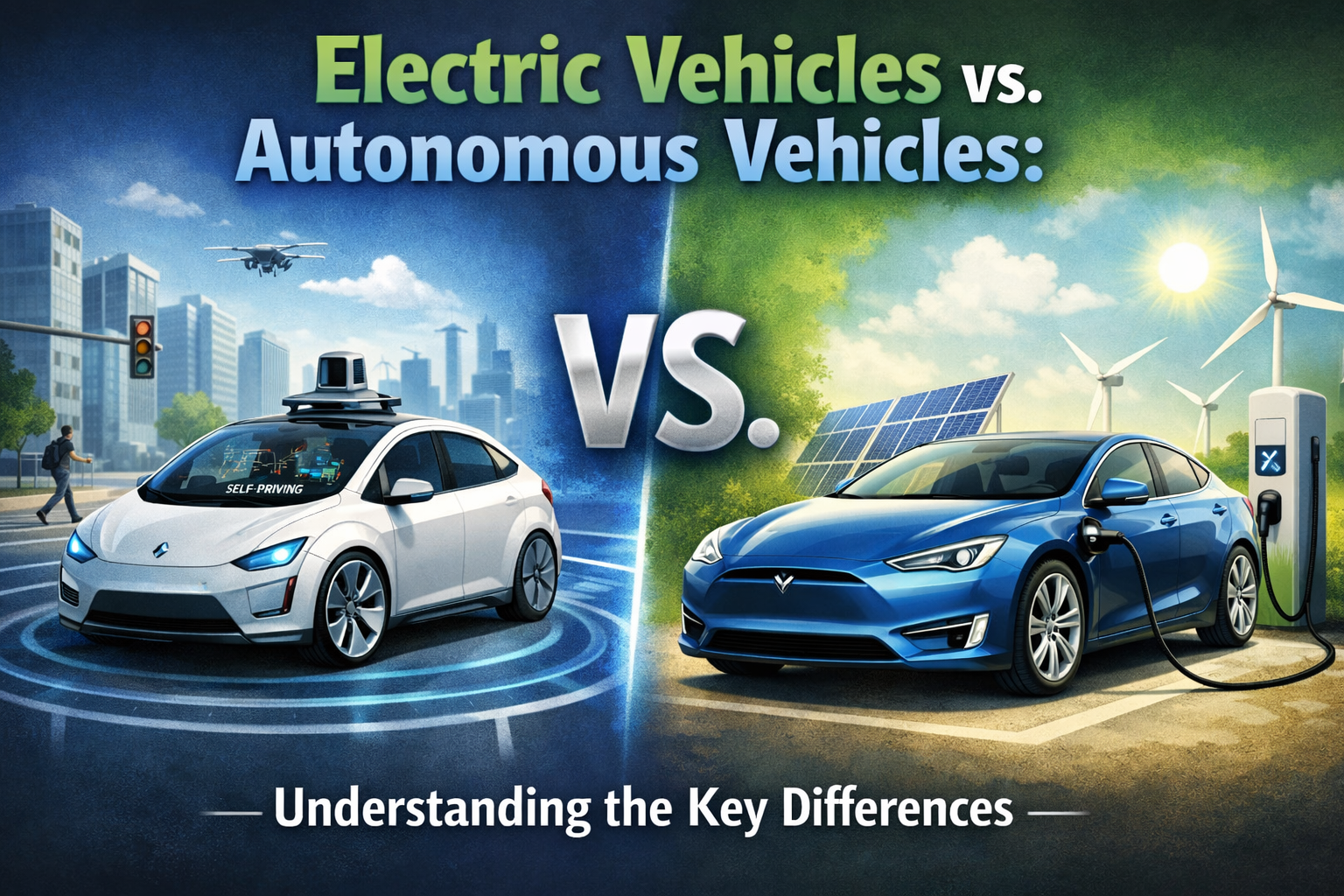
Electric vehicles (EVs) and autonomous vehicles (AVs) are two separate technologies. EVs are defined by their power source — they run on rechargeable batteries instead of gasoline. Autonomous vehicles are defined by their driving capability — they use AI, sensors, and cameras to navigate without a human driver. An EV still requires a human to drive it; an AV can be powered by gasoline, electricity, or hydrogen. The key difference: EVs address how a car is powered, while AVs address who or what controls it.
What Are Electric Vehicles?
Electric vehicles are automobiles powered by electric motors using energy stored in rechargeable batteries, rather than traditional internal combustion engines that burn gasoline or diesel. The core distinction of EVs lies in their power source and propulsion system. When comparing electric vehicles vs. autonomous vehicles, it’s important to recognize that EVs can be driven manually just like conventional cars.
Modern EV technology includes battery electric vehicles (BEVs) that run purely on electricity, and plug-in hybrid electric vehicles (PHEVs) that combine electric motors with traditional engines. Popular examples include the Tesla Model 3, Nissan Leaf, and Chevrolet Bolt. These vehicles produce zero tailpipe emissions, offer instant torque, require less maintenance than gas-powered cars, and contribute to reduced carbon footprints when charged with renewable energy.
The electric vehicle market has experienced explosive growth, driven by environmental concerns, government incentives, and rapid improvements in battery technology. Range anxiety—the fear of running out of charge—has diminished as newer EVs achieve 300+ miles per charge, and charging infrastructure continues expanding globally.
Read more: Top 10 Most Affordable Electric Vehicles
What Are Autonomous Vehicles?
Autonomous vehicles, commonly known as self-driving cars, are vehicles equipped with advanced sensors, cameras, radar, LiDAR, and artificial intelligence systems that enable them to navigate and operate without human intervention. The defining characteristic when discussing electric vehicles Vs. autonomous vehicles is that autonomous vehicles focus on driving capability, not power source.
Self-driving technology operates across six levels, ranging from Level 0 (no automation) to Level 5 (full automation requiring no human oversight). Most commercially available systems today function at Level 2 or 3, offering features like adaptive cruise control, lane keeping assistance, and automated parking. Companies like Waymo, Cruise, and Tesla are actively developing higher levels of autonomous driving technology.
Importantly, autonomous vehicles can be powered by any fuel type—gasoline, diesel, electricity, or hydrogen. The Waymo fleet uses electric vehicles, but the autonomous technology itself isn’t dependent on electric power. This represents a crucial distinction: an autonomous vehicle might be electric, but it doesn’t have to be, and electric vehicles certainly don’t need to be autonomous.
Read more: Autonomous Vehicle Technology Trends: AI, Sensors & Hardware
Key Differences Between Electric and Autonomous Vehicles
To truly understand electric vehicles vs. autonomous vehicles, we need to examine their fundamental differences across several dimensions. EVs are distinguished by their powertrain (battery-powered electric motor), which prioritizes sustainability and low running costs. AVs are defined by their ability to function autonomously using sensors.
Here’s a comprehensive comparison:
| Aspect | Electric Vehicles | Autonomous Vehicles |
|---|---|---|
| Primary Focus | Power source and propulsion system | Driving capability and control system |
| Technology Type | Battery, electric motor, charging system | AI, sensors, cameras, LiDAR, radar systems |
| Driver Requirement | Requires human driver | Can operate without human driver (at high automation levels) |
| Environmental Impact | Zero tailpipe emissions, reduced carbon footprint | Improved traffic flow and safety; environmental impact depends on power source |
| Current Availability | Widely available for consumer purchase | Limited availability; mostly testing and pilot programs |
Energy vs. Intelligence: Electric vehicles (EVs) cut tailpipe emissions but require charging infrastructure. AVs, such as the Waymo robotaxis, navigate surroundings without human interaction.
Read more: Autonomous Vehicle Systems & Levels
Can Electric and Autonomous Technologies Be Combined?
Here’s where things get interesting when examining electric vehicles vs. autonomous vehicles: these technologies are completely compatible and increasingly being integrated together. Many companies developing autonomous vehicles choose electric powertrains for several strategic reasons.
Electric vehicles offer simpler mechanical systems with fewer moving parts, making them ideal platforms for autonomous technology integration. The precise control possible with electric motors enables smoother autonomous operation. Additionally, the substantial electrical power available in EVs can support the energy-hungry sensors, computers, and AI systems that autonomous driving requires.
Tesla’s vehicles exemplify this convergence, offering both electric propulsion and advanced driver assistance features. Waymo’s autonomous taxi fleet operates entirely on electric Jaguar I-PACE vehicles. Cruise uses electric Chevrolet Bolt EVs for its autonomous ride-hailing service. This combination represents what many experts believe is the future: electric, autonomous vehicles delivering sustainable, safe, and convenient transportation.
Read more: Understanding V2X Technology in Autonomous Driving
Why Electric Platforms Are Ideal For Autonomous Technology
Here are some of the best reasons why electric platforms are ideal for autonomous technology:
- Simplified mechanical architecture: Electric vehicles have fewer moving parts than internal combustion engines, reducing potential failure points and making it easier to integrate complex autonomous systems without mechanical interference or reliability concerns.
- Precise electronic control: Electric motors offer instant torque response and millisecond-level control precision, enabling autonomous systems to execute smoother acceleration, braking, and steering adjustments that enhance passenger comfort and safety.
- Abundant electrical power supply: Autonomous vehicles require substantial computing power for AI processors, multiple sensors, cameras, and LiDAR systems. Electric vehicles’ large battery packs provide the necessary electrical capacity without draining a traditional 12-volt system.
- Advanced software integration: Electric vehicles are inherently software-defined platforms with sophisticated electronic control systems, creating a natural foundation for the AI-driven decision-making and over-the-air updates that autonomous technology demands.
- Lower operational costs for fleet deployment: Companies deploying autonomous ride-hailing or delivery services benefit from electric vehicles’ reduced maintenance requirements and lower per-mile energy costs, making autonomous EV fleets more economically viable for commercial operations.
Which Technology Is More Advanced Today?
When comparing electric vehicles vs. autonomous vehicles in terms of market readiness, electric vehicles are significantly more mature and commercially available. You can walk into a dealership today and purchase a fully electric vehicle that performs reliably for everyday use. EV technology has proven itself across millions of vehicles and billions of miles driven.
Autonomous vehicle technology, while advancing rapidly, remains largely in testing and pilot phases. Full Level 5 autonomy—where vehicles can drive anywhere under any conditions without human oversight—doesn’t yet exist commercially. Current self-driving systems operate in geofenced areas or require human supervision. Regulatory frameworks, liability questions, and public acceptance issues still need resolution before widespread autonomous vehicle deployment.
However, both technologies are evolving quickly. EV battery technology continues improving, with solid-state batteries promising even greater range and faster charging. Autonomous systems become more capable with each software update, learning from millions of miles of real-world driving data. The timeline for fully autonomous vehicles remains uncertain, with estimates ranging from a few years to a decade or more, depending on who you ask.
Read more: Autonomous Vehicle Safety & Testing Protocols
Frequently Asked Questions
Here are answers to the most common questions about electric vehicles vs. autonomous vehicles.
Are all autonomous vehicles electric?
No, autonomous vehicles can use any power source—gasoline, diesel, electricity, or hydrogen. While many companies developing self-driving technology choose electric powertrains, the autonomous driving capability is independent of how the vehicle is powered. Electric drivetrains are currently preferred because they offer precise, repeatable control, make it easier to add high-performance computing sensors, and lower total ownership costs. This makes EVs a better and more efficient platform for self-driving taxi fleets.
Do electric vehicles drive themselves?
Not automatically. Electric vehicles require human drivers just like gasoline cars unless they’re specifically equipped with autonomous driving technology. Being electric doesn’t make a vehicle self-driving; these are two separate, though increasingly combined, technologies. Although some new electric vehicles incorporate sophisticated driving assistance technology (DAV), they are nevertheless under manual control and thus lack the capacity to fully drive themselves.
Which technology will have a bigger impact on transportation?
Both will transform transportation profoundly. Electric vehicles directly address climate change through emission reductions. Autonomous vehicles promise to eliminate most traffic accidents caused by human error and revolutionize mobility access for people unable to drive.
Read more: 25 Technology Innovations Driving Business Growth
The Future of Mobility
Understanding electric vehicles vs. autonomous vehicles reveals they’re not competing technologies but complementary innovations reshaping transportation. Electric vehicles address sustainability by eliminating fossil fuel dependence and reducing emissions. Autonomous vehicles tackle safety and accessibility by removing human error from driving and providing mobility to those who cannot drive.
The convergence of these technologies promises transformative benefits: zero-emission autonomous taxis that operate 24/7, optimized traffic flow reducing congestion, and accessible transportation for elderly and disabled individuals. As battery technology improves and autonomous systems mature, we’re moving toward a future where electric, self-driving vehicles become the norm rather than the exception.
Whether you’re considering an electric vehicle purchase today or anticipating the arrival of fully autonomous transportation, understanding these distinct but interconnected technologies helps you navigate the evolving mobility landscape. The revolution isn’t about choosing one over the other—it’s about embracing both as essential components of our transportation future.
Related Contents:
- Autonomous Vehicle Safety & Testing Protocols
- Understanding V2X Technology in Autonomous Driving
- Autonomous Vehicle Technology Trends: AI, Sensors & Hardware
- Best GPS Navigation Systems for Autonomous Vehicles
- Top 10 Most Affordable Electric Vehicles
- Top 5 Electric Bikes For Daily Commuting
- Top 5 Electric Scooters for Urban Commuters
- 25 Technology Innovations Driving Business Growth
- Autonomous Vehicle Systems & Levels
- Sensor Fusion Technology in Autonomous Vehicles