
Written by: Segun Akomolafe
Influencer marketing has evolved from experimental campaigns to essential business strategy. Yet many brands still approach it haphazardly, throwing money at creators with large followings and hoping something sticks. Without a structured plan, you’re gambling with your marketing budget.
Learning how to create an influencer marketing strategy transforms guesswork into predictable growth. A well-designed strategy aligns influencer partnerships with business objectives, maximizes return on investment, and builds authentic connections with your target audience. This guide provides a step-by-step framework for developing influencer campaigns that drive measurable results.
Understanding the Strategic Foundation
Before reaching out to any influencer, you need clarity on what you’re trying to achieve. How to create an influencer marketing strategy starts with defining specific, measurable goals that connect to broader business objectives.
Are you launching a new product and need rapid awareness? Perhaps you’re struggling with customer acquisition costs and need a more efficient channel. Maybe your brand lacks credibility in a competitive market. Different objectives require different influencer approaches.
What does it mean? Consider a skincare brand targeting millennial women. If the goal is awareness, partnering with macro-influencers for reach makes sense. If conversion is a priority, micro-influencers with engaged niche audiences deliver better results. If building authority matters most, collaborating with dermatologists and skincare experts provides credibility flat-fee influencers cannot match.
Read more: Influencer Marketing You Need to Know
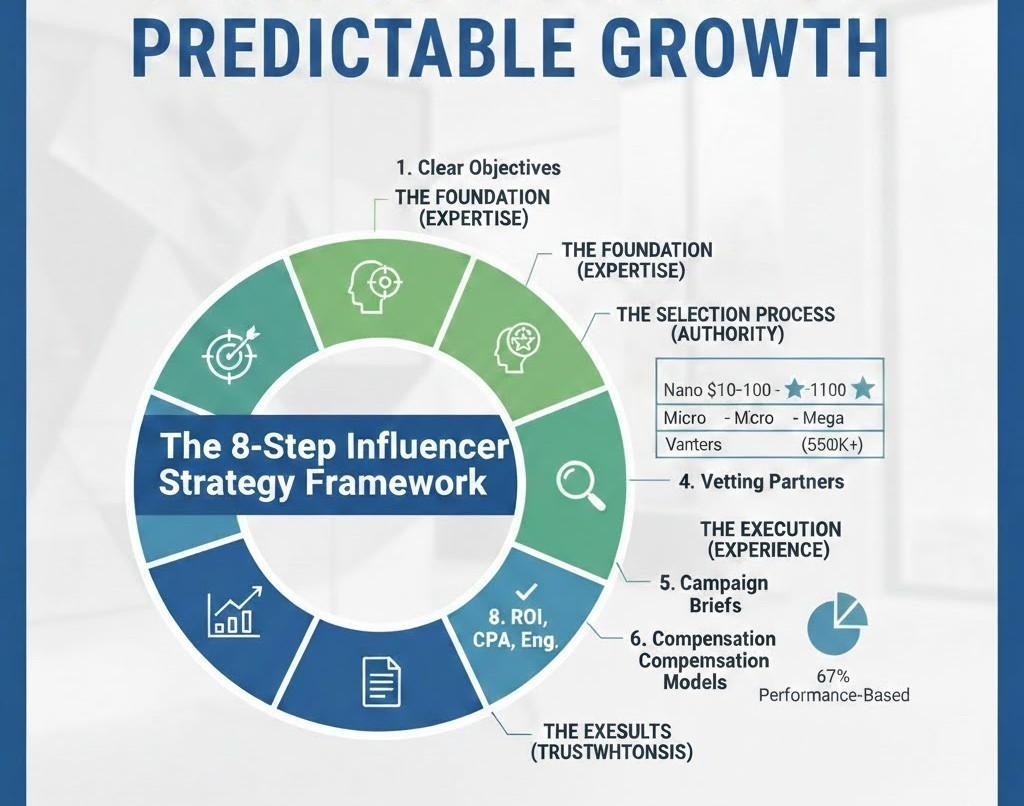
The Eight-Step Strategy Framework
Here are optimized details on the eight-step strategy framework for how to create an influencer marketing strategy.
Step 1: Define Clear Objectives and KPIs
Establish concrete goals with quantifiable metrics. For example, Instead of “increase brand awareness,” specify “generate 500,000 impressions and 2% engagement rate within 60 days.” Instead of “boost sales,” target “achieve 300 conversions at $45 cost per acquisition.”
What are the objectives here? Common objectives include brand awareness (impressions, reach, engagement), lead generation (email signups, downloads), sales conversion (revenue, units sold, ROI), and community building (followers, user-generated content). Each requires different measurement approaches and influencer selection criteria.
Step 2: Identify Your Target Audience
Understanding who you’re trying to reach determines which influencers can actually connect you with potential customers. How can you identify your target audience? Create detailed audience profiles covering demographics (age, gender, location, income), psychographics (values, interests, lifestyle), behavioral patterns (shopping habits, platform usage), and pain points your product solves.
A fitness supplement brand targeting amateur athletes needs different influencers than one targeting professional bodybuilders. The former might work with lifestyle fitness creators sharing workout routines, while the latter needs competitive athletes with serious credentials.
Step 3: Choose the Right Platforms
Not all social platforms suit every business. How to create an influencer marketing strategy that works means selecting platforms where your audience actively engages and your content format shines.
Instagram dominates fashion, beauty, and lifestyle sectors. YouTube excels for tutorials, reviews, and long-form storytelling. TikTok captures younger demographics with short, entertaining content. LinkedIn serves B2B brands targeting professionals. Podcasts build deep audience relationships through extended conversations.
Analyze where your competitors succeed, where your target customers spend time, and which formats best showcase your products. Most successful strategies focus resources on two or three platforms rather than spreading thin across all channels.
Read more: The Ultimate Guide to Instagram Marketing
Step 4: Select the Right Influencer Tier
Influencer tiers offer different advantages at varying price points:
| Influencer Tier | Follower Range | Typical Cost | Best For |
|---|---|---|---|
| Nano-Influencers | 1K-10K | $10-$100 per post | Hyper-local campaigns, niche products, authentic testimonials |
| Micro-Influencers | 10K-100K | $100-$1,000 per post | Targeted audiences, high engagement, cost-effective conversions |
| Mid-Tier Influencers | 100K-500K | $1,000-$10,000 per post | Balance of reach and engagement, established credibility |
| Macro-Influencers | 500K-1M | $10,000-$50,000 per post | Mass awareness, brand visibility, aspirational appeal |
| Mega Influencers | 1M+ | $50,000-$500,000+ per post | Maximum reach, brand prestige, cultural moments |
Budget, goals, and product type determine optimal tier selection. Many successful strategies combine tiers—using macro-influencers for awareness and micro-influencers for conversion.
Read more: Micro-Influencers vs. Mega-Influencers: Which Delivers Better ROI?
Step 5: Find and Vet Potential Partners
Discovering the right influencers requires research beyond follower counts. Look for creators whose audience demographics align with your target market, whose content style matches your brand aesthetic, whose engagement rates indicate genuine audience connection (2-5% for Instagram, 8-12% for TikTok), and whose values align with your brand positioning.
Use influencer marketing platforms like Upfluence, or CreatorIQ for systematic discovery. Search relevant hashtags and explore “similar accounts” features. Monitor competitors’ influencer partnerships. Request media kits showing audience demographics, engagement metrics, and previous brand collaborations.
Scrutinize for red flags like sudden follower spikes suggesting purchased followers, comments filled with spam or generic emojis indicating bot activity, engagement rates dramatically higher or lower than their tier average, and misalignment between audience interests and your product category.
Read more: How to Find the Right Influencers for Your Brand
Step 6: Develop Compensation Models
How to create an influencer marketing strategy includes choosing payment structures that protect your investment while motivating influencers. Options include flat fees for guaranteed deliverables, performance-based compensation tied to results, product gifting for smaller creators or testing relationships, and hybrid models combining base payment with performance bonuses.
Performance-based models have gained significant traction. How valid is this? Well, according to industry data, 67% of brands now incorporate outcome-driven compensation, reducing financial risk while aligning incentives.
Read more: What to Include in an Influencer Contract (+ Free Template)
Step 7: Create Campaign Guidelines and Content Briefs
Provide influencers with clear direction while allowing creative freedom. Effective briefs include campaign objectives and key messages, required deliverables (number of posts, stories, videos), content dos and don’ts, brand hashtags and mentions, disclosure requirements for FTC compliance, timeline and posting schedule, and performance tracking mechanisms (affiliate links, discount codes, UTM parameters).
Balance is crucial. Why? Because overly restrictive guidelines produce inauthentic content that audiences ignore. Too much freedom risks off-brand messaging that doesn’t serve your objectives. Share brand style guides and product information, but trust influencers’ understanding of what resonates with their followers.
Step 8: Measure, Analyze, and Optimize
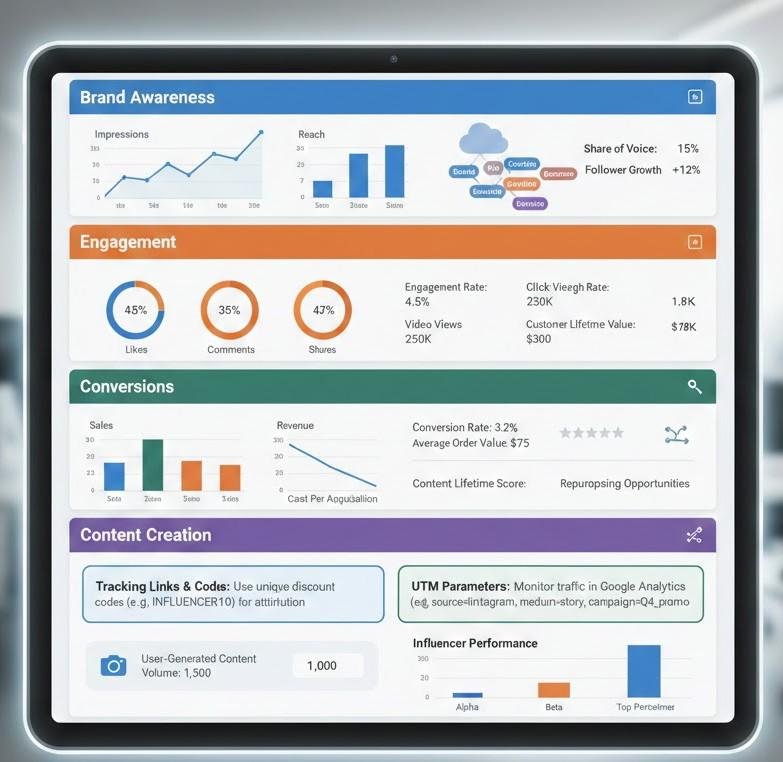
Tracking performance determines whether your strategy succeeds and reveals optimization opportunities. Monitor metrics aligned with your objectives:
| Goal | Primary Metrics | Secondary Metrics |
|---|---|---|
| Brand Awareness | Impressions, Reach, Brand Mentions | Share of Voice, Follower Growth |
| Engagement | Likes, Comments, Shares, Saves | Engagement Rate, Video Views, Click-Through Rate |
| Conversions | Sales, Revenue, Cost Per Acquisition | Conversion Rate, Average Order Value, Customer Lifetime Value |
| Content Creation | User-Generated Content Volume | Content Quality Score, Repurposing Opportunities |
Use tracking links and unique discount codes for accurate attribution. Implement UTM parameters to monitor traffic sources in Google Analytics. Compare performance across influencers to identify top performers worthy of long-term partnerships.
Read more: How to Measure Influencer Marketing ROI
Building Long-Term Partnerships
One-off collaborations rarely maximize influencer marketing potential. How to create an influencer marketing strategy for sustained success means developing ongoing relationships with proven performers.
Offer exclusive partnerships or brand ambassador programs to top-performing influencers. Provide early product access, involve them in product development feedback, and create co-branded content or limited editions. What’s the advantage? These deeper relationships transform influencers from vendors into genuine brand advocates who authentically promote your products because they believe in them.
Long-term partnerships also improve efficiency. Onboarding new influencers requires time explaining brand values, product details, and content expectations. Established partners already understand your brand, produce on-brand content faster, and often negotiate better rates for ongoing commitments.
Read more: The Ultimate Guide to YouTube Marketing
Leveraging Technology and Automation
Managing multiple influencer relationships manually becomes overwhelming as programs scale. Why? Because influencer marketing platforms automate discovery, outreach, contract management, content approval, performance tracking, and payment processing.
Tools like GRIN, AspireIQ, and CreatorIQ centralize campaign management, providing real-time dashboards showing ROI across all partnerships. Automation frees your team to focus on strategy and relationship building rather than administrative tasks.
Read more: Influencer Marketing Automation: Tools That Save Time
Common Strategy Mistakes to Avoid
Even well-intentioned strategies fail when brands make these errors:
Prioritizing follower count over engagement quality leads to expensive partnerships with minimal impact. An influencer with 500,000 followers but 0.5% engagement delivers worse results than one with 50,000 followers and 5% engagement.
Neglecting audience alignment wastes budget. A beauty influencer with millions of followers won’t drive skincare sales if their audience primarily follows for fashion content.
Insufficient tracking prevents learning and optimization. Without proper attribution, you cannot identify which influencers, content types, or platforms deliver best returns.
Overly controlling content guidelines produce stiff, inauthentic posts audiences scroll past. Trust influencers’ creative judgment about what resonates with their followers.
Read more: How to Utilize ChatGPT for Marketing Strategy
Frequently Asked Questions
Here are the top 3 frequently asked questions on how to create an influencer marketing strategy;
How much should I budget for influencer marketing?
Allocate 10-25% of your total marketing budget for influencer partnerships. Start with smaller investments to test effectiveness, then scale successful approaches based on proven ROI and performance data.
How long does it take to see results?
Brand awareness campaigns show immediate metrics like impressions and engagement. Conversion-focused campaigns typically need 30-90 days to accumulate meaningful data and optimize based on performance insights.
Should I work with one influencer or many?
Diversify across multiple influencers to reduce risk and test different audiences. However, prioritize quality over quantity. What does this mean? It means five engaged micro-influencers outperform twenty misaligned partnerships every time.
Conclusion
Understanding how to create an influencer marketing strategy transforms creator partnerships from expensive experiments into predictable revenue drivers. Success requires clear objectives, audience insights, platform selection, appropriate influencer tiers, thorough vetting, fair compensation, creative guidelines, and rigorous measurement.
Start with focused campaigns testing different approaches. Identify what works, double down on successful partnerships, and continuously refine based on performance data. The brands winning with influencer marketing treat it as strategic investment requiring the same rigor as paid advertising or content marketing.
As the influencer landscape evolves toward performance-based models and deeper brand partnerships, businesses that master strategic influencer marketing will capture attention, build trust, and drive growth in ways traditional advertising cannot match.
Related Contents:
- The Ultimate Guide to Performance-Based Influencer Marketing
- What to Include in an Influencer Contract (+ Free Template)
- How to Measure Influencer Marketing ROI
- Micro-Influencers vs. Mega-Influencers: Which Delivers Better ROI?
- Influencer Marketing You Need to Know
- The Ultimate Guide to Instagram Marketing
- The Ultimate Guide to Growing Your Online Business
- The Ultimate Guide to YouTube Marketing
- How to Find the Right Influencers for Your Brand
- Influencer Marketing Automation: Tools That Save Time