
Written by: Segun Akomolafe
Are you confused about choosing between micro-influencers vs. mega-influencers for your marketing budget? You’re not alone!
Many brand owners struggle with this decision every day. Should you spend millions on a celebrity with 50 million followers, or work with several smaller influencers who have thousands of engaged followers?
In this guide, we’ll explore the micro-influencers vs. mega-influencers debate to help you make the right choice for your business. We’ll look at costs, engagement rates, and real-world results so you can maximize your marketing ROI.
Let’s dive in.
Quick Answer
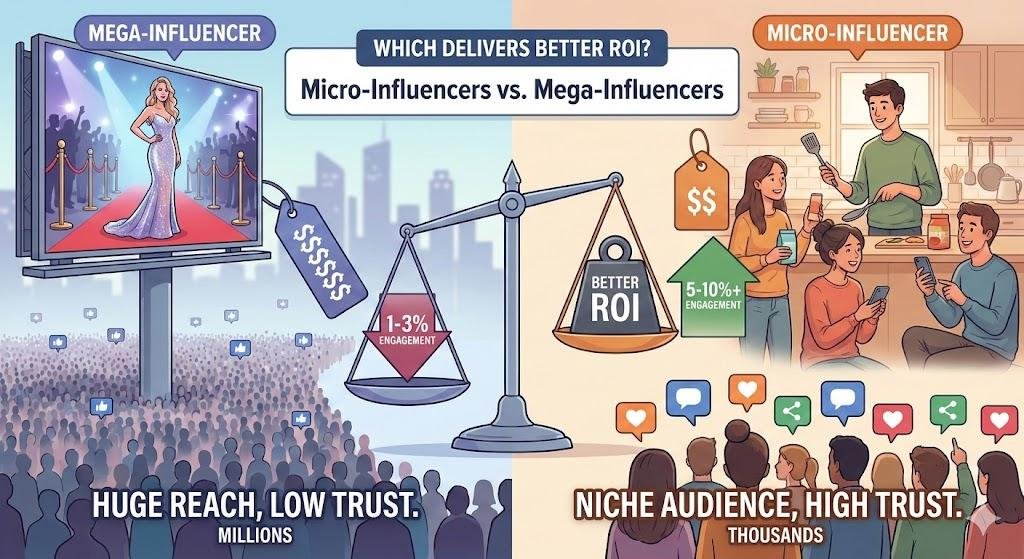
For most businesses, micro-influencers deliver better ROI. With follower counts between 10,000 and 100,000, they generate engagement rates of 5–10% compared to just 1–3% for mega-influencers with over 1 million followers. They cost significantly less — $100 to $5,000 per post versus $10,000 to $1 million — meaning you can run campaigns with 10 to 20 micro-influencers for the price of a single celebrity post.
Their niche audiences are more targeted, their recommendations are more trusted, and a 2026 study cited in this article shows micro-influencers delivered 4.2x higher ROI than celebrity-level collaborations. Mega-influencers still make sense for large brands that need massive awareness fast, but for conversion-focused campaigns, micro-influencers consistently outperform on cost per result.
What Are Micro-Influencers and Mega-Influencers?
Before we compare these two types of influencers, let’s define what makes them different.
Mega-Influencers
Mega-influencers are the big celebrities you see everywhere. They have over 1 million followers on social media platforms like Instagram, TikTok, and YouTube. Some examples include famous actors, musicians, athletes, and global personalities.
These influencers have massive reach and can expose your brand to millions of people with just one post. However, their services come with a heavy price tag, often ranging from $10,000 to over $1 million per post depending on their popularity.
Micro-Influencers
Micro-influencers are content creators with follower counts between 10,000 to 100,000. They may not be household names, but they have built loyal communities around specific niches like fitness, cooking, fashion, or technology.
These influencers typically charge between $100 to $5,000 per post, making them much more affordable for small and medium-sized businesses.
Read more: Influencer Marketing You Need to Know
The Cost Comparison: Who Fits Your Budget?
Let’s talk about money because this is often the first factor brand owners consider when evaluating micro-influencers vs. mega-influencers.
Mega-Influencers Pricing
When you hire a mega-influencer, you’re paying for their massive audience. A single Instagram post from someone with over 100 million followers can cost as much as $1 million. Even lesser-known celebrities with 2 to 5 million followers can charge $50,000 to $100,000 per post.
For many small businesses, this pricing is simply out of reach. You might only afford one or two posts based on your financial budget.
Micro-Influencers Pricing
Micro-influencers offer much more flexibility with their pricing. You can work with 10 to 20 micro-influencers for the same price you’d pay one mega-influencer. This allows you to:
- Run longer campaigns that last several weeks or months
- Test different influencers to see who delivers the best results
- Reach multiple niche audiences instead of one broad audience
- Negotiate better deals, especially for long-term partnerships
Some micro-influencers are even willing to accept free products instead of cash payment, especially if they genuinely love your brand.
Engagement Rates: The Hidden Truth
Here’s something that surprises many marketers: bigger doesn’t always mean better when it comes to engagement.
Mega-Influencer Engagement
Despite having millions of followers, mega-influencers typically have lower engagement rates. Studies show that accounts with over 1 million followers average only 1-3% engagement rates. This means if a celebrity has 10 million followers, only 100,000 to 300,000 people might actually interact with their post.
Why does this happen? Several reasons:
- Many followers are passive observers who don’t actively engage
- Some followers may be fake accounts or bots
- Celebrity content often feels like advertising rather than genuine recommendations
- The audience is too broad and may not be interested in your specific product
Micro-Influencer Engagement
Micro-influencers consistently achieve higher engagement rates, often between 5-10% or even higher. Their smaller communities are more active, loyal, and trusting.
When a micro-influencer recommends a product, their followers see it as advice from a friend rather than a paid advertisement. This creates authentic connections that drive real action.
For example, if a fitness micro-influencer with 50,000 followers posts about your protein powder, you might get 3,000 to 5,000 engaged interactions. That’s a much better conversion opportunity than a mega-influencer post that reaches millions but generates little genuine interest.
In a nutshell, if you are to look at conversion power, because their audiences are more engaged, micro-influencers drive better conversion rates (sales). A 2026 study showed micro-influencers delivered 4.2x higher ROI compared to larger, celebrity-level collaborations.
Read more: The Ultimate Guide to Instagram Marketing
Authenticity and Trust: Who Do Consumers Believe?
In today’s market, consumers are smart. They can spot fake endorsements from a mile away. Today’s customers are more likely to trust peer reviews, expert recommendations and ethical business practices than traditional, polished advertising. To build real brand credibility, companies must practice radical transparency, utilize user-generated content and communicate consistently and honestly. This strategic shift takes digital marketing from being purely promotional to being highly relatable, organically improving your website’s E-E-A-T and long-term search engine visibility.
The Mega-Influencer Challenge
When a celebrity promotes 20 different products in a month, it’s hard to believe they actually use all of them. Consumers have become skeptical of celebrity endorsements because they know these influencers are paid huge sums to say positive things. To combat this consumer disbelief, today’s digital marketers must foster genuine audience trust through things like authentic product testing and clear disclosures.
This skepticism reduces the effectiveness of mega-influencer campaigns. People might see the ad, but they won’t necessarily trust the recommendation enough to make a purchase. This basically lowers the overall conversion rates, return on investment, and brand credibility for the promoted items.
The Micro-Influencer Advantage
Micro-influencers build their reputation on authenticity. They typically work with fewer brands and only promote products they genuinely believe in. Their followers trust their opinions because they’ve built personal relationships over time.
This trust translates directly into higher conversion rates. When a micro-influencer says “I’ve been using this for months and it changed my life,” their audience believes them. That belief drives purchases in a way that celebrity endorsements often cannot.
Niche Targeting: Reaching Your Ideal Customer
One of the biggest advantages of micro-influencers is their ability to reach highly specific audiences. This basically drives higher engagement rates, increasing brand trust, improving conversion rates, and fostering authentic, community-driven engagement for targeted, specialized marketing campaigns.
Mega-Influencers and Broad Audiences
When you work with a mega-influencer, you’re reaching a massive but diverse audience. If you sell vegan skincare products, a general celebrity’s followers might include people who don’t care about veganism or skincare at all. You’re wasting money reaching people who will never become customers.
Micro-Influencers and Precision Marketing
Micro-influencers specialize in specific niches. You can find a vegan beauty micro-influencer whose entire audience is passionate about cruelty-free products. Every dollar you spend reaches someone who is already interested in what you offer.
This precision targeting means higher ROI because you’re not wasting impressions on irrelevant audiences. You’re speaking directly to people who are most likely to buy.
Read more: The Ultimate Guide to Growing Your Online Business
Real-World ROI Examples
Let’s look at some practical scenarios to understand the micro-influencers vs. mega-influencers ROI difference.
Scenario 1: Fashion Brand with $50,000 Budget
Option A: Hire one mega-influencer for $50,000, get one post reaching 5 million people with 2% engagement (100,000 interactions), potentially generating 500 sales.
Option B: Hire 25 micro-influencers at $2,000 each, get 25 posts reaching 1.5 million people total with 7% engagement (105,000 interactions), potentially generating 1,200 sales due to higher trust and targeting.
In this scenario, micro-influencers deliver more than double the sales for the same investment.
Scenario 2: Brand Awareness Campaign
If your goal is simply to get your brand name in front of as many eyes as possible, mega-influencers might make sense. A single post from a mega-influencer can create instant visibility and credibility, especially if you’re launching a new brand.
However, visibility doesn’t always equal sales. Putting these social campaigns with your SEO content marketing strategies ensures you capture valuable organic search traffic later. You need to consider what happens after people see the ad.
Read more: The 4 Best AI Apps For Marketers
Which Strategy Should You Choose?
The answer depends on your specific goals, budget, and brand stage.
Choose Mega-Influencers If:
- You have a large marketing budget ($100,000+)
- You’re launching a new brand and need massive awareness quickly
- Your product appeals to a very broad audience
- You want to build brand prestige through celebrity association
- You’re running a one-time campaign for maximum visibility
- You want to secure licensing, large-scale PR coverage and broader media features from a single partnership
Choose Micro-Influencers If:
- You have a limited budget (under $50,000)
- You want higher engagement and conversion rates
- Your product serves a specific niche audience
- You value authenticity and long-term customer relationships
- You want to test multiple influencers to find the best fit
- You’re focused on direct ROI rather than just brand awareness
- You need an easy avenue to generate a high volume of quality user-generated content (UGC) for your own brand channels
The Hybrid Approach: Best of Both Worlds
Many successful brands don’t choose between micro and mega influencers. They use both strategically.
You can hire one mega-influencer for a major campaign launch to create buzz and credibility. Then, use multiple micro-influencers for ongoing campaigns to drive consistent engagement and sales.
This hybrid approach gives you the visibility of celebrity endorsements plus the authenticity and conversions of niche influencer marketing.
How to Maximize ROI with Any Influencer
Regardless of which type you choose, follow these tips to get the best results:
1. Set Clear Goals: Know whether you want brand awareness, engagement, or direct sales
2. Check Their Engagement: Don’t just look at follower counts, check comments and shares
3. Review Past Partnerships: See how they’ve promoted other brands
4. Negotiate Contracts: Include deliverables, posting schedules, and performance metrics
5. Track Results: Use unique discount codes or affiliate links to measure actual conversions
6. Build Long-Term Relationships: Repeat collaborations perform better than one-off posts. Extend the life of the campaign by whitelisting, boosting or sharing top performing influencer content on your own brand channels
Conclusion
When it comes to ROI, the micro-influencers vs. mega-influencers decision usually favors micro-influencers for most businesses, especially those with limited budgets. Their higher engagement rates, authentic connections, and niche targeting create more conversions per dollar spent.
Mega-influencers still have their place, particularly for major brands seeking massive visibility or companies with large marketing budgets. However, the data consistently shows that smaller influencers often outperform celebrities when it comes to driving actual business results.
The best strategy is to test both approaches if your budget allows. Start with a few micro-influencers to prove the concept, measure your ROI, and then scale up or experiment with larger influencers as your results justify the investment.
Related Contents: